Voice, Streaming, and Low-Latency Interaction Patterns
Real-time AI systems like voice assistants and meeting copilots demand radical rethinking of UX, infrastructure, and prompt design. When 200ms delays break conversational flow, streaming responses become essential, edge computing necessary, and every architectural choice matters for maintaining natural human-AI dialogue rhythm.
2/24/20253 min read
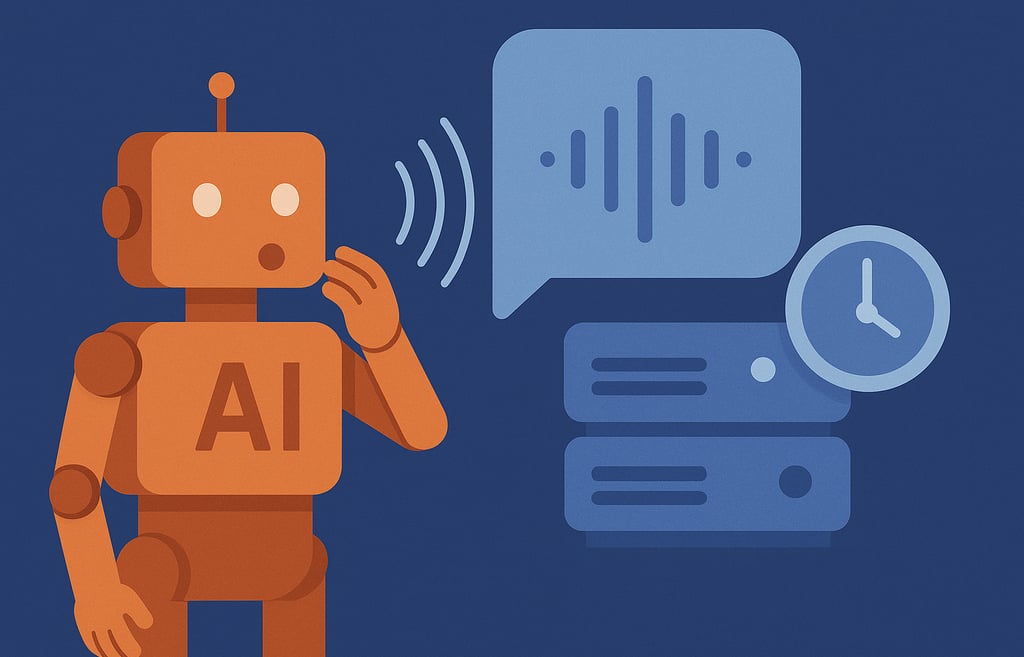
The shift from batch processing to real-time AI interaction represents one of the most significant transformations in how we design and deploy intelligent systems. When AI moves from answering queries in seconds to responding in milliseconds, everything changes. Voice assistants, live meeting copilots, and streaming chat interfaces aren't just faster versions of traditional chatbots—they require fundamentally different approaches to UX, infrastructure, and prompt engineering.
The 200-Millisecond Threshold
Human conversation flows naturally at around 200-300 milliseconds of acceptable response delay. Beyond this threshold, interactions feel sluggish and conversational rhythm breaks down. This isn't arbitrary—it's rooted in how our brains process dialogue. When building voice bots or live assistants, every millisecond counts. A system that takes 800ms to respond feels broken, even if it delivers perfect answers.
This constraint forces architectural decisions that would seem excessive in traditional applications. Real-time AI systems often deploy models closer to users through edge computing, use smaller specialized models rather than large general-purpose ones, and implement aggressive caching strategies. The infrastructure becomes distributed and latency-optimized by necessity.
Streaming as a Core Pattern
Traditional AI interactions follow a request-response pattern: send a complete prompt, wait, receive a complete answer. Real-time systems flip this model. Streaming responses, where tokens appear progressively as they're generated, transform the user experience from "waiting for AI" to "thinking with AI."
This shift impacts how we design prompts. In streaming contexts, front-loading important information becomes critical. Users see the first words immediately, so those words must be meaningful. Prompts need to guide models toward immediate relevance rather than lengthy preambles. The instruction "Answer concisely, starting with the key point" isn't just good practice—it's essential for maintaining conversational flow.
Streaming also introduces new failure modes. Incomplete responses, mid-generation errors, and context switches all become visible to users. Robust error handling and graceful degradation matter more than in batch systems, where failures happen behind the scenes.
Voice-Specific Challenges
Voice interfaces compound latency challenges with speech recognition and synthesis overhead. The pipeline—audio capture, speech-to-text, LLM processing, text-to-speech, audio playback—creates multiple points where delays accumulate. Optimizing real-time voice AI means optimizing the entire chain, not just the language model.
This drives adoption of multimodal models that can process audio directly, bypassing transcription latency. It also explains the rise of techniques like speculative decoding and model quantization, which sacrifice some accuracy for dramatic speed improvements. In voice contexts, a slightly less perfect answer delivered instantly often provides better UX than a perfect answer that arrives after an awkward pause.
Prompt design for voice differs significantly from text. Responses must be speakable—avoiding complex formatting, long lists, or dense information. Instructions like "respond conversationally" or "use simple sentence structure" become functional requirements, not stylistic choices.
Live Meeting Copilots and Context Management
Real-time meeting assistants face unique challenges around context windows and relevance. Unlike turn-based chat, where context is relatively static between exchanges, live meetings involve continuous audio streams and rapidly shifting topics. The system must decide what's relevant right now while maintaining enough context for coherent responses.
This creates tension between comprehensiveness and speed. Prompts for meeting copilots often include explicit instructions about recency weighting: "Focus on the last 30 seconds of conversation" or "Prioritize recent speakers when summarizing." The prompt becomes a real-time filter, not just a query.
Infrastructure Implications
Supporting real-time AI at scale requires rethinking traditional ML infrastructure. WebSockets replace REST APIs for maintaining persistent connections. Server-Sent Events enable efficient one-way streaming. Edge deployment moves computation closer to users, reducing network latency.
Load balancing becomes more complex—sticky sessions matter when conversations maintain state. Connection stability becomes critical; a dropped connection mid-sentence destroys the experience. Monitoring shifts from tracking batch job completion times to measuring percentile latencies: p50, p95, p99 response times under load.
The Prompt Engineering Shift
Perhaps the most subtle change involves how we craft prompts. Traditional prompt engineering optimizes for accuracy and completeness. Real-time prompt engineering optimizes for progressive disclosure—delivering value at every stage of response generation.
This means structuring prompts to encourage models toward immediate utility: answer the question first, then elaborate. It means being explicit about brevity constraints. It means testing prompts not just for correctness but for perceived responsiveness.
Looking Forward
As models become faster and infrastructure more sophisticated, the 200-millisecond barrier will blur. The distinction between "real-time" and "normal" AI will fade. But the lessons learned building today's voice bots and streaming interfaces—about latency, about progressive disclosure, about the human experience of conversational rhythm—will remain foundational to how we design intelligent systems.