Unified Search 2.0: Blending LLMs with Metrics, Logs, and Structured Data
Unified Search 2.0 leverages LLMs to orchestrate queries across metrics, logs, tickets, and databases simultaneously. Unlike traditional search, it understands intent, translates questions into system-specific queries, and synthesizes answers while citing sources. This transforms enterprise search from keyword matching to intelligent investigation across fragmented data ecosystems.
10/6/20253 min read
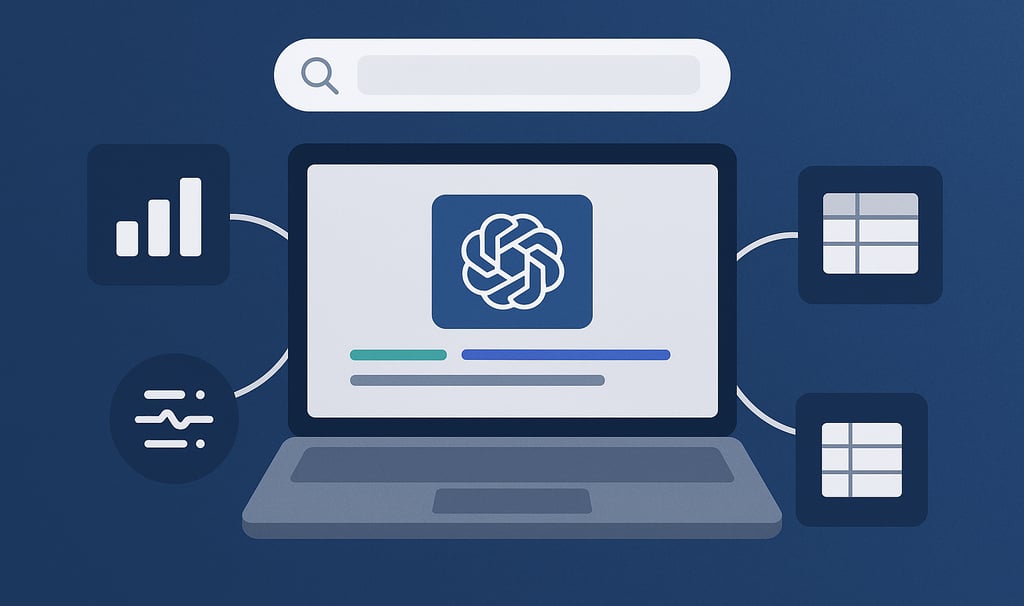
The evolution of enterprise search has reached an inflection point. For years, organizations have struggled with information fragmentation—critical insights scattered across observability platforms, ticketing systems, documentation repositories, and data warehouses. Teams waste countless hours switching between tools, manually correlating events, and reconstructing context from disparate sources. The promise of unified search isn't new, but its execution has historically fallen short, delivering rudimentary keyword matching across limited data types.
Enter Unified Search 2.0, a paradigm shift that leverages large language models as intelligent orchestration layers atop heterogeneous data ecosystems. Unlike traditional search interfaces that return static result lists, this next-generation approach understands intent, dynamically routes queries across multiple systems, and synthesizes findings while preserving traceability to source data.
The Architecture of Intelligence
At its core, Unified Search 2.0 operates as a multi-agent system. When an engineer asks, "Why did checkout latency spike at 3 AM last Tuesday?", the LLM doesn't simply match keywords. Instead, it decomposes the question into structured sub-queries: retrieving time-series metrics from Prometheus, pulling application logs from Elasticsearch, fetching related incident tickets from Jira, and querying deployment history from a PostgreSQL database.
This orchestration happens intelligently. The LLM identifies which systems hold relevant information, translates natural language into system-specific query languages—PromQL for metrics, SQL for databases, Lucene syntax for log aggregation—and executes these queries in parallel. The result is a comprehensive answer that might explain: "Latency increased 340% following a deployment at 2:47 AM. Error logs show database connection pool exhaustion. Related ticket #3847 documents a similar issue resolved by adjusting connection timeouts."
Beyond Keyword Matching
Traditional search treats all data as text to be indexed and matched. Unified Search 2.0 respects data semantics. Metrics remain quantitative time-series, logs retain their structured fields and timestamps, and databases preserve relational integrity. The LLM doesn't flatten everything into embeddings; rather, it maintains awareness of each system's strengths and query capabilities.
This semantic understanding enables sophisticated cross-system reasoning. When investigating a customer complaint, the system might correlate sentiment analysis from support tickets with error rate metrics, specific user session logs, and feature flag configurations—all while recognizing temporal relationships and causal patterns that would remain invisible in siloed searches.
Transparency and Trust
The Achilles' heel of many AI-powered tools is their black-box nature. Unified Search 2.0 addresses this through radical transparency. Every synthesized answer includes citations to source systems, timestamps, and deep links to raw data. Users can verify claims, explore underlying datasets, and understand the reasoning chain that produced results.
This isn't just about trust—it's about empowerment. An engineer reviewing a post-mortem can click through to the exact dashboard panel showing CPU utilization, the specific log lines indicating OOM errors, and the configuration change that triggered the cascade. The LLM serves as a guide, not a gatekeeper, lowering the barrier to investigation while maintaining data integrity.
Real-World Applications
The impact spans domains. DevOps teams diagnose production incidents faster by instantly accessing correlated signals across their observability stack. Security analysts investigate potential breaches by querying authentication logs, network flow data, and threat intelligence feeds simultaneously. Business analysts answer complex questions like "Which customer segments experienced the most friction during our last mobile app update?" by combining product analytics, support tickets, and user session replays.
Product managers can ask, "Show me all features shipped last quarter that had usage below 10% and generated support tickets"—a query that traditionally required manual investigation across product management tools, analytics platforms, and support systems.
Challenges Ahead
This vision isn't without obstacles. Data governance remains critical—LLMs must respect access controls across systems, ensuring users only see data they're authorized to access. Latency is another consideration; orchestrating queries across many systems requires optimization to maintain sub-second response times. And there's the perpetual challenge of keeping LLMs grounded in factual data rather than hallucinating plausible-sounding answers.
The frontier of enterprise search has moved beyond finding documents to understanding systems. Unified Search 2.0 represents a fundamental shift in how organizations access and synthesize information, transforming search from a retrieval problem into an intelligence problem. As LLMs mature and data integration deepens, the question shifts from "Where is this information?" to simply "What happened, and why?"