The Second Wave of LLMs, Long Context, Better Tools, Deeper Integration
The Second Wave of LLMs is here. Discover how long context windows, advanced agentic tools, and mature RAG stacks are moving AI beyond simple chatbots. This analysis breaks down what these 2025 shifts mean for teams ready to build reliable, deeply integrated, and transformative enterprise AI applications.
1/13/20253 min read
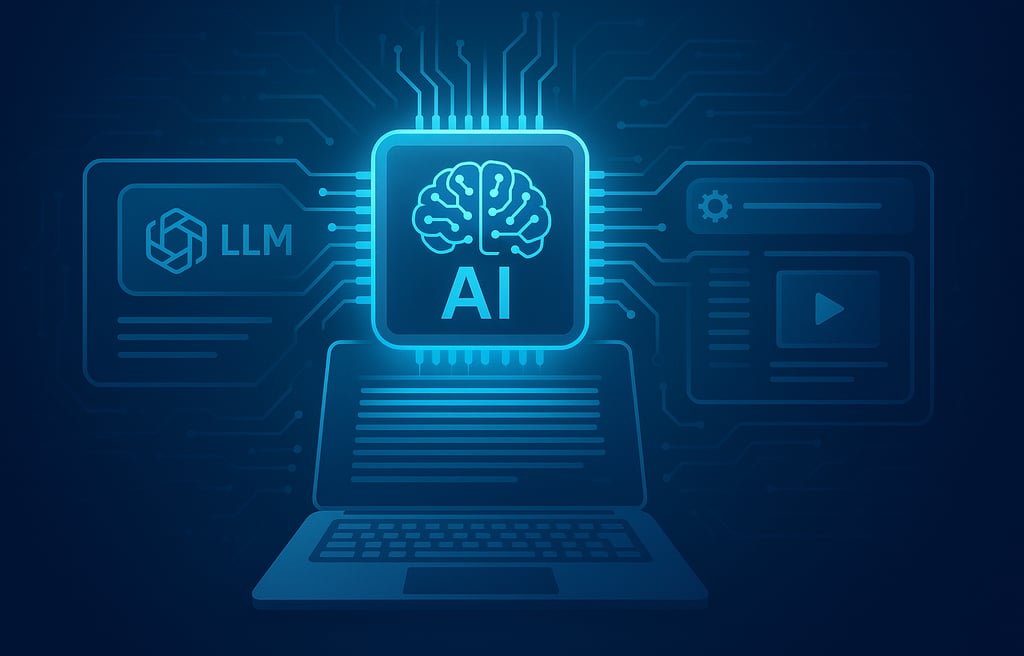
The first wave of Large Language Models (LLMs), sparked by the public release of ChatGPT, was defined by raw generative power and viral adoption. It democratized AI, turning a niche technology into a global phenomenon. Now, in early 2025, we are squarely in the Second Wave—a phase focused not just on generating text, but on reliability, integration, and operational efficiency. The core shift is from a dazzling standalone technology to a deeply woven enterprise utility.
This transition is characterized by three fundamental advancements: Long Context, Better Tools (Agents), and Deeper Integration—primarily through mature Retrieval-Augmented Generation (RAG) stacks. For every team planning its next phase of AI adoption, understanding this new foundation is critical.
The Power of Persistent Memory: Long Context Models
The most immediate and transformative change is the exponential growth in the context window of frontier models. Where early LLMs struggled to remember the beginning of a long conversation or process a full document, today’s models can handle inputs measured in the millions of tokens.
Handling the Full Document: Long-context LLMs can now ingest and reason over entire legal contracts, full company handbooks, multi-hour transcripts, or vast technical manuals in a single prompt. This significantly improves tasks like deep summarization, complex Q&A, and cross-document analysis.
Reduced Fragmentation: Previously, complex tasks had to be broken into smaller, context-limited chunks. The new, expansive context window eliminates this fragmentation, leading to more coherent, consistent, and accurate outputs.
Challenges Remain: While revolutionary, long-context is not a silver bullet. The "lost in the middle" problem—where models struggle to recall information buried deep within a massive prompt—still exists, and the token and compute costs of these super-sized requests remain significantly higher than traditional approaches.
From Chatbots to Specialists: Better Tools and Agentic AI
The next major evolution moves LLMs beyond being passive text generators to becoming active AI Agents. This shift is enabled by robust tool-calling or function-calling capabilities, allowing the LLM to interact with external systems.
Planning and Execution: Agents can now break down complex, multi-step user requests (e.g., "Find the Q4 sales data, summarize it, and draft an email to the sales team") into a sequence of actions.
External Data Access: The LLM's "brain" is now connected to "hands" that can use external tools like databases, proprietary APIs, coding environments, or even web search in real-time. This dramatically increases the scope and utility of AI applications.
Enterprise Automation: The focus for 2025 is on Agentic Workflows—automating entire business processes, from handling a customer service ticket end-to-end to performing deep competitive analysis using multiple public and internal data sources. This is where the most significant productivity gains are being realized.
Grounding Intelligence: Maturing RAG Stacks
The third pillar of the Second Wave is the maturity of Retrieval-Augmented Generation (RAG) stacks. RAG is the enterprise strategy for grounding LLMs in proprietary, up-to-date, and factual data, dramatically mitigating the risk of hallucinations.
Accuracy and Traceability: Advanced RAG systems now feature sophisticated re-ranking, hybrid search, and metadata filtering to ensure the LLM receives the most relevant information. Crucially, RAG provides source traceability, allowing users to see exactly which internal document backed the model’s answer, which is essential for compliance and trust in regulated industries.
RAG vs. Long Context: The conversation has moved from RAG or Long Context to RAG and Long Context. RAG remains the most cost-effective and dynamic solution for frequently updated or vast, dispersed knowledge bases. Long-context models, however, are now being used within the RAG pipeline—for instance, to more effectively process and synthesize the large, retrieved chunks of information before generating the final answer.
The Hybrid Approach: The most successful enterprise deployments in 2025 are adopting a hybrid architecture that uses long-context models for deep summarization of static documents and RAG for accessing and grounding answers in dynamic, live data.
Implications for Teams: Planning the Next Phase of Adoption
For teams and organizations, the arrival of the Second Wave demands a strategic shift away from simple "let's use ChatGPT" pilots to architecting reliable, production-ready AI systems.
Shift Focus from LLM Choice to Orchestration: The core competitive advantage no longer lies solely in the specific foundation model (GPT, Gemini, Claude, etc.) but in the quality of the RAG and Agentic orchestration layer. Invest in data engineering, vector database management, and robust evaluation metrics (Evals).
Architect for Hybridity: Do not commit to a single architecture. The smart strategy involves building systems that can dynamically route a query—to a long-context model for static document analysis, or to a RAG pipeline for a question requiring up-to-the-minute data.
Governance is Non-Negotiable: With deeper integration, the risks of poor performance and data leakage are higher. Implement strict data governance, quality assurance steps within the RAG pipeline, and clear safety guardrails for Agentic actions.
The Second Wave is transforming AI from an impressive demo into a foundational layer of business operations. The teams that successfully navigate the complexities of long-context, tool-use, and advanced RAG stacks will be the ones that define the enterprise landscape of 2025 and beyond.