Synthetic Data and LLMs, When (and When Not) to Let AI Train AI
Synthetic data generated by LLMs offers powerful solutions for training and evaluation, but using AI to train AI creates dangerous feedback loops. Learn when synthetic data accelerates progress in code generation and edge-case testing, and when it amplifies biases and causes model collapse—plus strategies for getting the balance right.
2/10/20253 min read
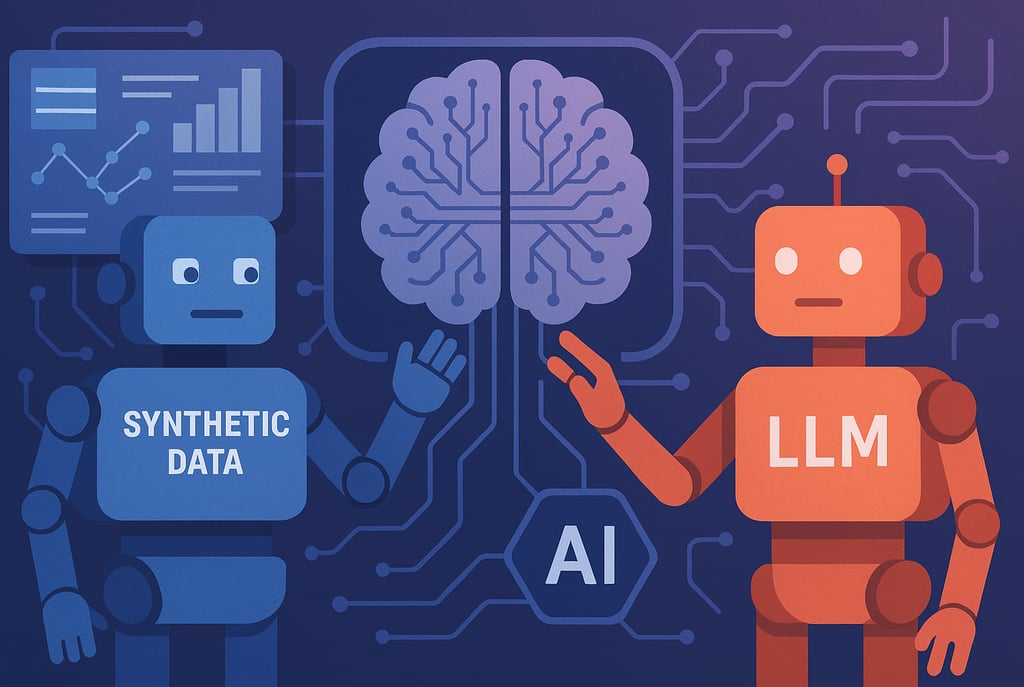
The machine learning community finds itself in a peculiar paradox. As large language models become more capable, researchers increasingly turn to these same models to generate the training data for the next generation of AI systems. It's a recursive loop that promises efficiency and scale, but also raises a fundamental question: can AI meaningfully improve itself, or are we simply teaching machines to echo their own limitations?
Synthetic data—information generated by algorithms rather than collected from the real world—has emerged as a pragmatic solution to several pressing challenges in AI development. High-quality labeled data remains expensive and time-consuming to produce. Privacy regulations restrict access to sensitive information. And certain edge cases occur so rarely in natural datasets that models struggle to learn them. LLM-generated data offers an appealing workaround to all these constraints.
The approach has proven genuinely valuable in specific contexts. When fine-tuning models for structured tasks like code generation, synthetic examples can provide diverse test cases that human engineers might not anticipate. Researchers at major AI labs have successfully used GPT-4 to generate training data for smaller, specialized models, creating datasets with precise annotations that would require prohibitive human effort. For evaluation purposes, synthetic data excels at stress-testing models against adversarial inputs or exploring performance across systematically varied conditions.
Mathematical reasoning presents another success story. LLMs can generate thousands of algebra problems with verified solutions, helping train models on logical chains of reasoning. This controlled environment allows researchers to isolate specific capabilities and measure incremental improvements with precision. Similarly, for low-resource languages where parallel text is scarce, synthetic translations—despite their imperfections—can bootstrap systems that eventually improve through exposure to authentic data.
Yet the enthusiasm for synthetic data crashes against hard limitations that no amount of engineering can fully overcome. The most obvious problem is what researchers call "model collapse"—when AI systems trained predominantly on synthetic data begin to lose the diversity and nuance present in human-generated content. Recent studies have shown that recursive training, where each generation of models learns from the outputs of previous generations, leads to progressive degradation in output quality and creativity.
The issue runs deeper than mere statistical drift. LLMs generate plausible text based on patterns they've learned, but they cannot introduce genuinely novel information beyond their training distribution. When we use synthetic data to teach models about the world, we're essentially having them learn from a distorted reflection rather than reality itself. The model learns the biases, gaps, and hallucinations embedded in the synthetic data generator, amplifying rather than correcting existing flaws.
Cultural nuance and subjective judgment prove particularly resistant to synthetic approaches. An LLM can generate thousands of examples of "toxic" language, but these examples will necessarily reflect the model's learned associations rather than the complex, context-dependent nature of how language causes harm in human communities. Training on such data risks codifying oversimplified proxies for genuinely difficult problems.
The feedback loop concern extends to evaluation as well. When researchers use LLM-generated test sets to benchmark LLM performance, they create a closed system that may miss entirely new failure modes. Models become adept at handling synthetic adversarial examples while remaining brittle against authentic edge cases that emerge from genuine human use.
So where does this leave practitioners? The emerging consensus suggests synthetic data works best as a supplement rather than a replacement for human-generated information. Use it to augment sparse real-world datasets, not to substitute for them entirely. Deploy it for structured, verifiable tasks where correctness can be automatically checked—code that must compile, mathematical proofs that can be verified, logical reasoning chains that follow clear rules.
Reserve human data for the messy, subjective dimensions of language: cultural context, emotional nuance, ethical judgment, and creative expression. Maintain diversity in training sources to prevent model collapse, and implement robust human evaluation pipelines that catch problems synthetic benchmarks miss.
The technology continues evolving rapidly. Researchers are developing techniques to detect and filter low-quality synthetic examples, methods to measure and preserve data diversity, and hybrid approaches that strategically combine human and machine-generated content. But the fundamental tension remains: AI systems can accelerate and scale the data creation process, but they cannot transcend their own limitations without grounding in authentic human knowledge and experience.