Structured Reasoning Over Enterprise Data
Enterprise AI is evolving beyond pure LLM approaches. This article explores how organizations combine large language models with knowledge graphs for structured reasoning, enabling natural language access to complex business data while maintaining accuracy, auditability, and the ability to reason across relationships—solving the limitations of "free-text only" architectures.
2/17/20253 min read
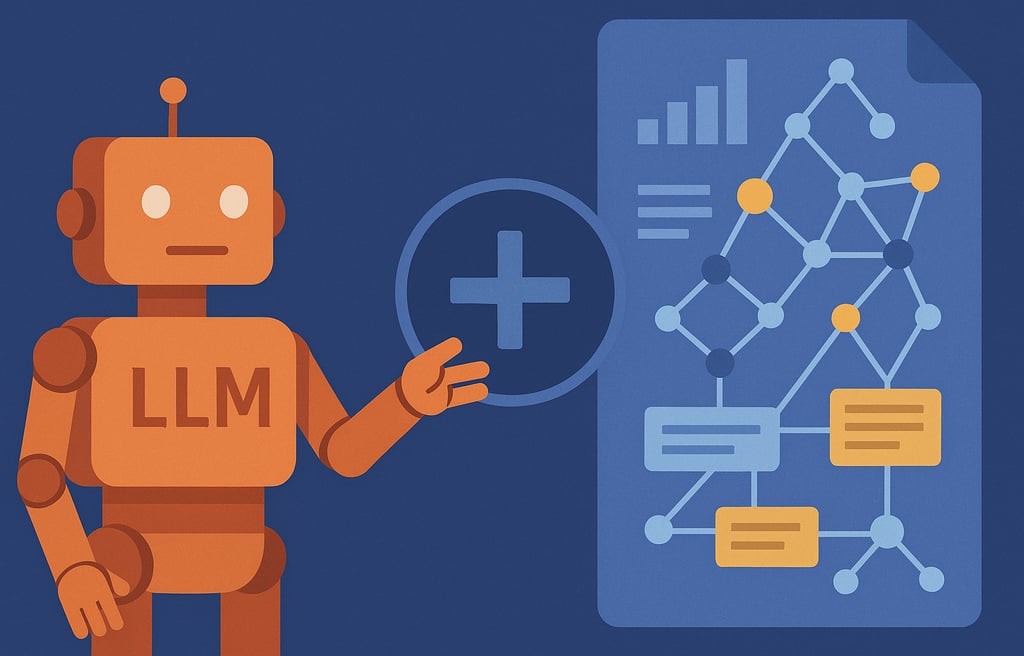
The enterprise AI landscape is undergoing a fundamental shift. While large language models have dominated headlines with their conversational prowess, forward-thinking organizations are discovering that LLMs alone aren't enough for mission-critical business intelligence. The future belongs to hybrid architectures that marry the natural language capabilities of LLMs with the precision and reliability of knowledge graphs and structured data systems.
The Limitations of Free-Text Architectures
Early enterprise LLM deployments often followed a simple pattern: dump documents into a vector database, use retrieval-augmented generation (RAG), and hope for the best. This "free-text only" approach delivers impressive demos but struggles in production environments where accuracy, auditability, and consistency matter.
The problems are multifaceted. Vector search returns semantically similar chunks, but similarity doesn't guarantee relevance or correctness. LLMs can hallucinate connections between unrelated facts. Most critically, pure text-based systems lack the structural understanding necessary to answer complex queries that require reasoning across relationships—like "Which customers who purchased Product A in Q4 also had support tickets related to Feature B?"
Enter the Knowledge Graph
Knowledge graphs represent information as networks of entities and relationships. Unlike flat text, they capture the inherent structure of business data: products relate to categories, customers have transaction histories, employees belong to departments. This explicit modeling of relationships enables precise traversal and inference that text embeddings simply cannot match.
Leading enterprises are now building hybrid systems where knowledge graphs serve as the structured backbone while LLMs provide the natural language interface. Financial institutions map regulatory frameworks as graphs, enabling compliance officers to ask nuanced questions about rule interactions. Healthcare organizations model patient journeys, clinical guidelines, and research findings in graph databases, allowing physicians to query complex treatment pathways conversationally.
Schema-Aware Prompting: Teaching LLMs Structure
The key to effective LLM-graph integration lies in schema-aware prompting. Rather than treating the LLM as a black box, engineers provide explicit context about the underlying data structure within prompts. This might include entity types, relationship definitions, and constraint rules.
For example, a prompt might begin: "You have access to a customer database with the following schema: Customer entities connect to Purchase entities via 'bought' relationships, and to SupportTicket entities via 'filed' relationships. When answering questions, first identify relevant entity types and relationships, then construct appropriate graph queries."
This approach transforms the LLM from a statistical pattern matcher into an intelligent query planner. The model learns to decompose natural language questions into structured retrieval operations, execute those operations against the graph, and synthesize results into human-readable responses.
Practical Implementation Patterns
Several architectural patterns have emerged from production deployments. The most robust implementations use a multi-stage pipeline: natural language understanding extracts intent and entities, a query planner generates graph traversal operations (often in languages like Cypher or SPARQL), the graph database executes these queries with guaranteed correctness, and finally the LLM synthesizes results into natural language.
Companies like Bloomberg and Thomson Reuters are pioneering this approach for financial analysis, where accuracy is non-negotiable. Their systems allow analysts to ask questions like "Show me aerospace companies with declining margins but increasing R&D spend" and receive answers grounded in verified, structured financial data rather than probabilistic text generation.
Another powerful pattern involves using knowledge graphs for validation and fact-checking. After an LLM generates a response, the system verifies claims against the graph, flagging any inconsistencies. This catches hallucinations before they reach users while maintaining the fluidity of natural language interaction.
The Road Ahead
The convergence of LLMs and knowledge graphs represents a maturation of enterprise AI. Organizations are moving beyond "AI for AI's sake" toward architectures that leverage the strengths of different technologies: LLMs for natural language understanding and generation, graphs for structured reasoning and relationship modeling, and vector databases for semantic search where appropriate.
This isn't about replacing one technology with another—it's about thoughtful integration. The most sophisticated systems being deployed in 2025 use LLMs as intelligent orchestrators that know when to query structured data, when to search vector stores, when to invoke specialized APIs, and how to combine results coherently.
For enterprises serious about operationalizing AI, the lesson is clear: structured reasoning over enterprise data requires structured data systems. Knowledge graphs provide the foundation for reliable, auditable, and truly intelligent business applications.