Skills for the Post-ChatGPT Professional: Prompting, Verification, and AI Literacy
Ten months post-ChatGPT, a skills gap is emerging between AI-fluent and AI-hesitant professionals. Success requires mastering AI briefing, rigorous output verification, and hybrid workflows combining search with LLMs. Rather than fearing replacement, professionals should focus on designing AI-augmented processes that multiply their expertise and productivity across core tasks.
10/2/20233 min read
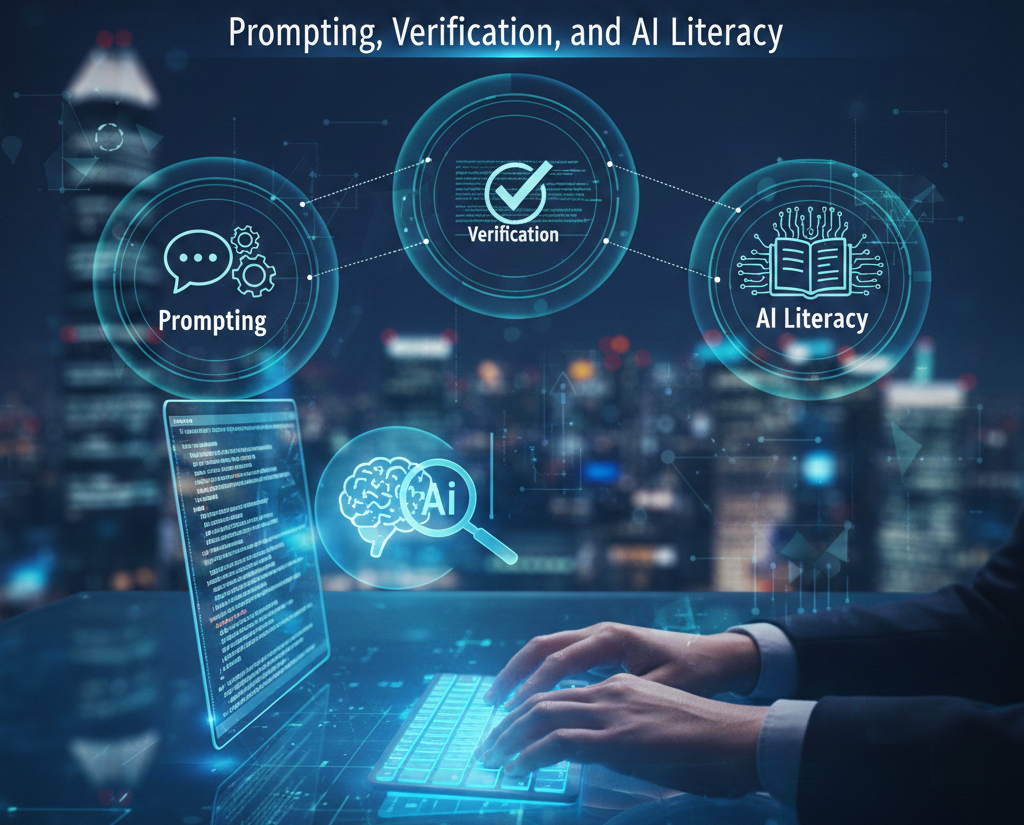
Ten months after ChatGPT's launch, the professional landscape has shifted in ways both subtle and profound. The question is no longer whether AI will impact your career—it already has. The relevant question is whether you're developing the skills to thrive in this new environment or watching from the sidelines as colleagues race ahead.
The anxiety is understandable. Every professional publication runs headlines about AI replacing jobs. But the reality emerging from early adoption is more nuanced: AI isn't replacing professionals wholesale. It's creating a growing divide between those who can effectively leverage these tools and those who cannot.
The New Core Competency: AI Briefing
The most valuable skill in the AI era isn't coding or data science—it's the ability to effectively brief AI systems. Think of it as a new form of delegation, but one requiring precision and clarity that many professionals haven't needed before.
Good prompting isn't about magic words or secret techniques. It's about clear communication of context, constraints, and desired outcomes. Professionals who excel at briefing human colleagues—providing relevant background, specifying format requirements, anticipating edge cases—are discovering these same skills translate directly to working with AI.
The difference is that AI requires even more explicitness. When you ask a colleague to draft a client email, they understand implicitly that it should be professional, concise, and avoid obvious pitfalls. AI needs these norms stated. Learning to identify and articulate these implicit requirements is becoming a fundamental professional skill.
Effective briefing also means iteration. The first output is rarely the final product. Professionals skilled in AI collaboration treat initial responses as drafts, then refine through follow-up prompts that clarify, expand, or redirect. This iterative dialogue—not one-shot prompting—is where real productivity gains emerge.
Verification: The Indispensable Counterweight
As AI tools become more fluent and confident-sounding, the ability to verify their outputs becomes increasingly critical. AI systems hallucinate facts, misunderstand context, and generate plausible-sounding nonsense with alarming regularity. The professional who treats AI output as gospel is building on quicksand.
Verification requires domain expertise—you need to know enough about your field to spot errors, inconsistencies, and logical gaps. This is why AI augments rather than replaces expertise. The junior analyst who uses ChatGPT to write a market analysis without understanding market dynamics will produce dangerous nonsense. The senior analyst who uses it to accelerate research and draft synthesis can multiply their output.
Developing verification skills means cultivating healthy skepticism. Cross-reference facts against reliable sources. Question logical leaps. Test recommendations against your professional judgment. The goal isn't to distrust AI completely but to verify intelligently—checking the elements most likely to be wrong while trusting patterns that align with your expertise.
Blending Search and AI: The Hybrid Approach
The most effective professionals aren't choosing between traditional search and AI tools—they're developing workflows that combine both. Google remains superior for finding specific, recent information. ChatGPT excels at synthesis, explanation, and generating variations. Knowing which tool fits which task is becoming a core competency.
A typical hybrid workflow might use traditional search to find primary sources and recent data, then feed that information to an LLM for synthesis and analysis. Or start with an AI-generated overview to understand a new domain, then use targeted searches to verify specific claims and find authoritative sources.
This hybrid approach extends beyond just search and chat. The professionals pulling ahead are those integrating AI across their entire toolkit: using AI for initial drafts but human judgment for strategy, employing AI for data analysis but human insight for interpretation, leveraging AI for research but human expertise for decision-making.
Designing AI-Augmented Workflows
Perhaps the most valuable skill is thinking systematically about where AI fits in your work. This requires honest assessment of your daily tasks: which are repetitive and well-defined (ideal for AI), which require creativity within constraints (good for AI collaboration), and which demand judgment and relationship skills (still fundamentally human).
The goal isn't to automate yourself out of a job but to automate the parts of your job that drain time without adding value. Every professional has tasks they find tedious—formatting reports, summarizing meetings, drafting routine correspondence, conducting preliminary research. These are often perfect candidates for AI augmentation.
Start small. Pick one repetitive task and design an AI-assisted workflow for it. Measure the time saved and quality maintained. Refine based on what works and what doesn't. Gradually expand to other areas. The professionals who will thrive aren't those with the fanciest AI tools but those who systematically identify opportunities and methodically build better workflows.
The Path Forward
The divide between AI-fluent and AI-hesitant professionals will only widen. The former will handle larger workloads, deliver faster turnarounds, and take on more complex projects. The latter will find themselves increasingly outpaced, wondering why their productivity hasn't kept up.
The good news? These skills are learnable. They don't require technical backgrounds or expensive training. They require curiosity, experimentation, and a willingness to adapt your working methods. The professionals who embrace this learning—who view AI as a tool to master rather than a threat to fear—will define the next generation of workplace excellence.