Multi-Agent Systems, Collaboration, Coordination, and Chaos Control
Multi-agent AI systems promise specialized collaboration but face critical challenges: role confusion, infinite loops, memory conflicts, and coordination failures drive sixty to eighty percent of deployments to fail. Success requires crystal-clear role definitions, aggressive guardrails, structured conflict resolution, and honest assessment of when complexity justifies itself over simpler single-agent approaches.
3/10/20255 min read
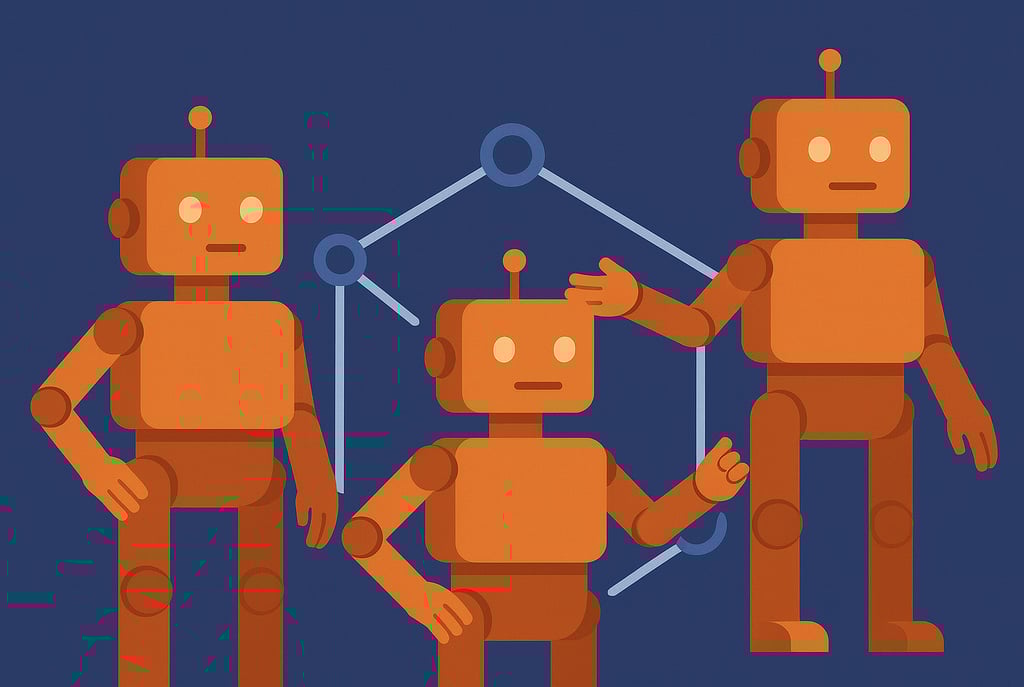
The promise of multi-agent AI systems sounds almost too good to be true: instead of relying on a single model to handle everything, why not deploy a team of specialized agents that collaborate like human experts? One agent plans, another researches, a third executes, and a fourth verifies. The logic is compelling—until reality intervenes.
As we move deeper into 2025, the gap between multi-agent demos and production deployments remains stubbornly wide. Research indicates that between sixty and eighty percent of multi-agent systems encounter failures when deployed in real-world environments. This isn't due to random glitches or model limitations. The failures stem from predictable structural problems in how these systems coordinate, communicate, and control their collective behavior.
The Architecture of Collaboration
Multi-agent systems typically employ an orchestrator-worker pattern, where a lead agent coordinates the process while delegating to specialized subagents that operate in parallel. Think of it as a digital management hierarchy: the orchestrator analyzes incoming queries, develops strategies, and spawns specialized agents to tackle different aspects simultaneously.
Each agent is designed with distinct roles, personas, and contexts in mind, enabling them to operate effectively within a multi-agent framework. A data analyst agent might retrieve information, while a writer agent synthesizes findings into coherent narratives. Meanwhile, a reviewer agent validates outputs for accuracy and completeness.
The appeal is obvious. By distributing cognitive labor across specialized units, systems can theoretically handle more complex workflows than any single agent could manage alone. Multi-agent collaboration enables decentralized, autonomous agents to work together to achieve collective or interdependent goals, helping to overcome some of the structural limitations of constrained single-agent systems.
The Coordination Challenge
But here's where theory meets turbulence. Coordinating multiple autonomous agents requires more than simply connecting them with API calls. Agents cooperate by using established communication protocols to exchange state information, assign responsibilities and coordinate actions, including methods for work decomposition, resource distribution, conflict resolution and cooperative planning.
Without these foundations, chaos emerges. Agents duplicate work, pursuing the same subtasks independently. They create circular dependencies where Agent A waits for Agent B, which in turn waits for Agent C, which requires output from Agent A. Without proper orchestration, you get duplicated work, circular loops or outright deadlocks.
The problem intensifies with scale. When agents have to actually be reliable while running for long periods of time and maintain coherent conversations, there are certain things you must do to contain the potential for compounding errors. A minor miscommunication between two agents can cascade into system-wide failures as downstream agents make decisions based on faulty assumptions.
Division of Labor and Role Definition
Successful multi-agent systems require crystal-clear role boundaries. By explicitly defining roles, we avoid overlap and confusion. Each agent needs to know not just what it should do, but what it shouldn't do—and when to escalate rather than proceeding independently.
Consider a research workflow. The planner agent decomposes complex queries into manageable subtasks. The researcher agents execute parallel searches across different domains. The synthesizer agent combines findings into coherent insights. The validator agent checks for consistency and accuracy. Each role is distinct, yet all contribute to a unified goal.
But role definition alone isn't sufficient. Agents struggle to judge appropriate effort for different tasks, so scaling rules must be embedded in the prompts. Without guidance, an agent might spend thirty minutes researching a tangential point that deserves thirty seconds, or rush through a critical analysis that requires depth.
Conflict Resolution Protocols
When agents disagree or produce conflicting outputs, systems need structured resolution mechanisms. Conflicts might include two agents attempting the same task simultaneously, agents providing different answers or solutions to the same question, or resource conflicts like two agents trying to write to the same file.
Role-based conflict resolution uses predefined authority relationships or domain expertise hierarchies that determine which agent's decisions take precedence in conflict situations. Alternative approaches include voting systems where agents reach consensus, or arbitration by a higher-level coordinator agent.
The Model Context Protocol represents an emerging standard for addressing these challenges. With access to shared context through MCP, agents can better understand the rationale behind others' positions, identify potential compromises, and develop more effective resolution strategies.
The Infinite Loop Problem
Perhaps the most insidious failure mode is the infinite loop—when agents get stuck repeating actions without recognizing they're spinning in place. Some systems lack a robust method for determining when a task is complete, leading to infinite loops, excessive tool calls, or incomplete outputs that still get marked as done.
This happens for several reasons. Without shared memory or persistent context, agents forget what happened earlier in the task and may repeat steps, miss dependencies, or fail to recognize when a task has already been completed. An agent might search for information, forget it searched, and search again—burning through API calls and token budgets while making no progress.
Multi-agent systems need circuit breakers and timeouts to stop infinite loops. Hard limits on iterations, token budgets, and execution time act as safety nets. If an agent hasn't made progress after a defined threshold, the system should terminate the task and escalate to human review rather than continuing indefinitely.
Memory and Context Management
One of the subtlest challenges in multi-agent systems is memory management. Claude has no memory between completions, so the full conversation history must be included in each request. For a single agent, this is manageable. For multiple agents operating in parallel, it becomes a coordination nightmare.
Should all agents share the same memory? That creates coherence but limits parallelism and increases context window consumption. Should each agent maintain separate memory? That enables independence but risks agents working at cross purposes. Scoped memory that isolates agent logs by ID using append-only history can help, allowing agents to maintain their own state while sharing critical information through structured protocols.
Practical Boundaries and Design Principles
So what actually works? The most successful implementations in 2025 share several characteristics. First, they start simple. Single-agent synchronous patterns work best, as multi-agent orchestration introduces deadlocks, message passing failures, and progressive information distortion as agents pass it along.
Second, they implement aggressive guardrails. Maximum iteration counts, token budgets, and timeout limits prevent runaway processes. Tools are narrowly scoped—instead of giving agents a generic database query function, provide specific operations like retrieving user counts or updating configuration values.
Third, successful systems prioritize visibility and observability. Most monitoring tools were built for single-agent systems, leaving a major gap for distributed AI. Production deployments need comprehensive logging that tracks which agent performed what action, when, and why—enabling post-mortem analysis when things go wrong.
When to Use Multi-Agent Systems
Given these challenges, when does the complexity of multi-agent architecture justify itself? The answer lies in the nature of the task. Multi-agent systems excel when work can be genuinely parallelized—multiple independent research streams, parallel data processing pipelines, or simultaneous evaluation of different solution approaches.
They struggle when tasks require tight sequential dependencies, when context sharing overhead exceeds the benefits of specialization, or when the coordination complexity outweighs the gains from distribution. In many cases, ensuring every action is informed by the context of all relevant decisions made by other parts of the system works better than trying to coordinate independent agents.
The Path Forward
The multi-agent systems landscape in 2025 is neither the promised land nor a dead end. It's a maturing technology wrestling with fundamental coordination challenges that echo distributed systems problems from decades past—just with the added complexity of probabilistic language models making autonomous decisions.
The path forward requires honesty about limitations. Multi-agent systems are not inherently superior to well-designed single-agent architectures. They're a tool with specific use cases, significant overhead, and failure modes that demand careful engineering to address.
For organizations considering multi-agent deployments, the advice is pragmatic: start with the simplest architecture that could work, add agents only when parallelism provides clear benefits, implement comprehensive safety nets, and invest heavily in observability. The future of autonomous AI likely involves agent teams—but only if we can teach them to collaborate without collapsing into chaos.