Hybrid Reasoning
Hybrid reasoning systems combine LLMs with rule engines, constraint solvers, and classical AI to create more reliable applications. By letting language models handle ambiguity and understanding while deterministic components manage strict logic and calculations, teams build AI that is both intelligent and trustworthy.
5/5/20253 min read

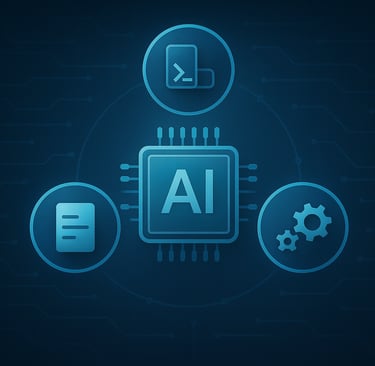
The promise of large language models has captivated industries worldwide, yet their limitations have become equally apparent. While LLMs excel at understanding context, generating natural language, and handling ambiguous inputs, they struggle with tasks requiring precision, consistent logic, and deterministic calculations. The solution emerging across enterprises is neither abandoning LLMs nor relying solely on traditional approaches, but rather architecting hybrid systems that leverage the complementary strengths of both paradigms.
The Reasoning Gap
Recent research confirms that LLMs are fundamentally pattern recognizers rather than procedural reasoners. When asked to perform multi-step arithmetic, enforce strict business rules, or solve constraint satisfaction problems, even frontier models stumble. IBM's ACPBench Hard benchmark reveals that models like GPT-4o score below 65% on core planning tasks involving action applicability and reachability. This isn't a flaw to be patched through better prompting—it's an architectural reality. LLMs generate outputs through probabilistic token prediction, not algorithmic execution.
Meanwhile, rule engines, constraint solvers, and classical AI systems handle precisely these deterministic tasks with reliability. SAT and SMT solvers can verify logical consistency across thousands of constraints. Rule-based systems execute business logic without deviation. But these systems lack flexibility—they require structured inputs, explicit programming, and struggle with the ambiguity inherent in natural language.
The Hybrid Architecture
The most effective production systems now deploy what researchers call neuro-symbolic architectures. These systems layer rule-based engines for structured tasks alongside LLMs that interpret natural language and manage user interaction. Rather than forcing one technology to handle everything, hybrid systems create clear divisions of labor.
In one common pattern, LLMs first process natural language to extract structured data, which then flows into deterministic rule engines that execute causal reasoning on that structured information. A financial services application might use an LLM to understand a loan application narrative, extract key facts into a structured format, then pass those facts to a rule engine that applies precise regulatory compliance checks. The LLM handles ambiguity and language understanding; the rule engine ensures mathematical accuracy and legal compliance.
Alternative architectures position the rule engine as the master controller, calling upon LLMs as needed for specific text processing or generation tasks. This approach keeps deterministic logic in control while leveraging neural capabilities for understanding and communication.
Constraint Solvers Meet Neural Networks
One of the most promising developments involves integrating LLMs with constraint programming and SAT/SMT solvers. Recent systems bridge language models with symbolic solvers through protocols that allow LLMs to translate problem statements in English into formal constraint encodings, which are then solved by specialized engines.
Tools like Logic.py provide LLMs with streamlined APIs to express search problems for constraint solvers, making formal reasoning more accessible while maintaining logical rigor. The LLM handles the cognitive load of understanding what the user wants, while the solver guarantees correctness of the solution.
Emerging frameworks like DiLA embed differential logic layers directly into neural architectures, allowing systems to combine neural perception with symbolic constraint satisfaction during inference. These approaches show how the boundary between neural and symbolic processing can become increasingly fluid, with each component contributing its strengths seamlessly.
Real-World Applications
In healthcare, hybrid models enable conversational interfaces for patient inquiries while ensuring all outputs comply with regulatory standards through rule-based filtering. The system engages naturally with patients while maintaining strict adherence to medical guidelines.
Manufacturing and logistics operations employ hybrid systems where LLMs generate workflow recommendations that are validated by formal logic engines enforcing operational constraints. The creative exploration of possibilities happens in the neural space, while feasibility verification occurs in the symbolic domain.
Systems like Claude 3.7 with reasoning scratchpads, AWS Bedrock integrating SMT solvers, and frameworks like H-STAR demonstrate how major platforms are moving toward this hybrid approach. These aren't research prototypes—they're production systems handling real workloads.
Design Principles for Hybrid Systems
Building effective hybrid architectures requires thoughtful division of responsibilities. Success depends on identifying which components benefit from structured symbolic representations versus flexible neural learning. Teams should route tasks requiring systematic logic, causal reasoning, and strict compliance through symbolic components, while directing natural language understanding, ambiguity resolution, and creative generation to neural systems.
Integration protocols matter immensely. Middleware coordinates the exchange of structured messages between layers, maintaining context and enabling seamless task handover. The goal is making the hybrid nature invisible to users while maintaining clear separation internally.
Recent studies show that architectures combining retrieval-augmented generation with symbolic verification consistently outperform single-paradigm approaches on complex multi-hop reasoning tasks. The synergy between neural flexibility and symbolic precision proves greater than either approach alone.
The Path Forward
The trajectory is clear: neither pure neural networks nor pure symbolic systems represent the future of AI. As demonstrated by Amazon's deployment of neuro-symbolic approaches in warehouse robots and shopping assistants during 2025, this hybrid methodology is becoming the practical path to reliable AI.
The question facing development teams is no longer whether to combine approaches, but how to architect the integration effectively. Those who master the art of hybrid reasoning—knowing when to leverage neural pattern recognition and when to enforce symbolic constraints—will build the most robust, trustworthy, and capable AI systems of this decade.