From Notebooks to Natural Language: How AI Is Rewiring Data Science Workflows
This article examines how LLMs are transforming data science workflows by introducing natural language interfaces alongside traditional tools like Jupyter notebooks, SQL, and Python. It explores SQL copilots, Code Interpreter's impact on analysis speed, and emerging notebook integrations, while analyzing implications for skills, organizational structure, and the future of business intelligence tools as conversational interfaces complement rather than replace technical depth.
8/14/202312 min read

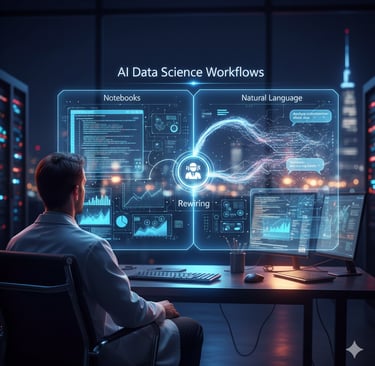
The data science workflow has remained remarkably stable for the past decade: Jupyter notebooks for exploration, SQL for data extraction, Python libraries for analysis, BI tools for visualization. Practitioners bounce between these tools, translating business questions into code, queries into insights, and analyses into stakeholder-friendly reports. Each translation point introduces friction, time loss, and potential for miscommunication.
Over the past eight months—since ChatGPT's launch and especially since Code Interpreter's July release—this workflow is fundamentally rewiring. Natural language is becoming a legitimate interface layer for data work, not as a replacement for technical depth but as a complementary modality that accelerates common tasks and democratizes sophisticated analyses.
The Traditional Data Science Stack
Understanding the transformation requires recognizing what's being transformed. The conventional workflow looks like this:
A stakeholder asks a business question: "Why did user retention drop last quarter?" The data scientist translates this into technical requirements: identify relevant tables, define retention metrics, determine cohort structures, select visualization approaches.
Next comes data extraction. Write SQL queries to pull user activity data, join across multiple tables, filter for relevant time periods, aggregate appropriately. Debug syntax errors, optimize for performance, validate row counts.
Analysis happens in Jupyter notebooks or similar environments. Import pandas, numpy, matplotlib. Clean data, handle missing values, compute metrics, run statistical tests, generate visualizations. Document assumptions and decisions in markdown cells.
Finally, communicate results. Export charts, write summary documents, present findings in meetings. Stakeholders ask follow-up questions requiring new analyses, and the cycle repeats.
Each step demands specific technical skills. SQL proficiency for extraction. Python expertise for analysis. Statistical knowledge for appropriate methods. Visualization judgment for clear communication. The skill requirements create natural bottlenecks—companies have more questions than data scientists to answer them.
The Natural Language Layer
LLMs introduce a new interaction modality at each workflow stage. Rather than eliminating existing tools, they create a natural language interface that operates alongside traditional methods.
SQL generation has matured rapidly. Tools like GitHub Copilot, Cody, and specialized SQL copilots translate English descriptions into database queries. "Show me monthly active users by acquisition channel for the past year" becomes syntactically correct SQL that joins the right tables, applies appropriate filters, and aggregates properly.
The accuracy is surprisingly high for straightforward queries. Data scientists report that AI-generated SQL works correctly 70-80% of the time for standard analytical queries, requiring minor adjustments rather than complete rewrites. This dramatically reduces the cognitive load of translating business logic into database operations.
More importantly, SQL copilots make database exploration more fluid. "What tables contain user purchase data?" "Show me the schema for the events table." "Give me a sample query joining users and transactions." Questions that previously required documentation searches or trial-and-error get immediate, accurate responses.
Code Interpreter transforms the analysis phase. As discussed in our previous examination, ChatGPT's Code Interpreter allows data scientists to upload datasets and request analyses conversationally. "Calculate monthly retention cohorts and visualize as a heatmap" generates pandas code, executes it, and returns the visualization—all without writing a line of code manually.
For exploratory analysis, this is transformative. Data scientists investigating unfamiliar datasets can rapidly test hypotheses, generate multiple visualizations, and identify interesting patterns without the overhead of writing and debugging code. The iteration speed increases dramatically.
Experienced data scientists appreciate Code Interpreter not for replacing their coding ability but for handling routine manipulations while they focus on interpretation and strategy. One senior analyst described it as "outsourcing the mechanical parts of analysis so I can think about what questions matter."
Jupyter integrations are emerging that blend traditional notebooks with LLM assistance. Extensions like Jupyter AI bring conversational capabilities directly into the notebook environment. Data scientists can ask questions about their data, request code generation for specific analyses, and get suggestions for next steps—all without leaving their workflow.
The integration feels natural because notebooks already mix code, results, and narrative. Adding conversational assistance enhances rather than disrupts the existing paradigm. Early adopters report that having an AI coding partner in the notebook environment reduces context-switching and maintains flow state better than external tools.
Real-World Workflow Changes
The abstract capabilities manifest in concrete workflow transformations:
Faster exploratory data analysis: Data scientists at several startups report that initial data exploration—understanding distributions, identifying relationships, spotting outliers—now takes hours instead of days. The ability to request visualizations conversationally, without writing plotting code, accelerates the discovery phase dramatically.
One analytics lead at a Series B SaaS company shared that their team now explores three times as many hypotheses per week. "We're not smarter, but we're faster at the mechanical parts. That compounds—more explorations mean more insights, which surface better questions."
Democratized analysis: Marketing, product, and operations teams with SQL knowledge but limited Python expertise can now perform sophisticated analyses previously requiring data science support. Code Interpreter bridges the gap between "I know what I want to analyze" and "I can implement that analysis in pandas."
A product manager described analyzing user cohort behavior independently for the first time. "I've always needed to request this from data science, waiting days for their bandwidth. Now I upload the data export, describe what I want, and iterate immediately. It's empowering."
Improved documentation: AI-generated code often includes clearer comments than human-written equivalents. When asking ChatGPT to "calculate customer lifetime value by acquisition channel," the resulting code explains each step explicitly. This improves reproducibility and knowledge transfer.
Several data teams report using AI to retrofit documentation onto legacy analyses. Upload old notebooks, ask ChatGPT to explain the logic and add comprehensive comments. This has accelerated onboarding and reduced bus factor risk.
Faster stakeholder responses: When executives ask follow-up questions during presentations, data scientists can generate answers in real-time rather than promising to "look into that and follow up." The ability to quickly modify analyses conversationally makes data scientists more responsive and increases confidence in data-driven decision-making.
Reduced technical debt: Teams report that AI-assisted coding produces cleaner, more maintainable code. AI naturally follows best practices—consistent naming conventions, modular functions, appropriate error handling. This reduces the technical debt that accumulates when data scientists hack together quick-and-dirty analyses under time pressure.
The SQL Copilot Evolution
SQL generation deserves deeper examination because database queries represent a particularly high-value translation problem. Business questions inherently map to data stored in tables, making SQL a natural target for natural language interfaces.
Text-to-SQL isn't new—researchers have worked on this problem for decades. What changed is accuracy reaching practical thresholds. GPT-4 and similar models handle complex queries involving multiple joins, subqueries, window functions, and conditional logic with reliability that earlier approaches never achieved.
The models understand context. If you ask "Show me our top customers," the model infers appropriate metrics (revenue, order frequency) and time windows (recent period) based on business context. Follow-up questions like "Now filter for customers acquired this year" maintain context, modifying the previous query appropriately.
Schema understanding has improved dramatically. Modern SQL copilots analyze database schemas—table structures, column types, relationships—and generate queries that respect these constraints. They avoid referencing non-existent columns, apply appropriate type casts, and use correct join keys.
Several startups are building specialized SQL copilots targeting this opportunity. Defog, Seek AI, and others focus exclusively on text-to-SQL for business intelligence, emphasizing accuracy, data governance, and enterprise deployment. These tools integrate with data warehouses (Snowflake, BigQuery, Redshift) and learn organizational-specific conventions.
Query optimization represents an emerging capability. Some tools not only generate SQL but suggest optimizations—index hints, query restructuring, materialized view opportunities. This knowledge transfer helps less experienced analysts write more efficient queries.
The impact on data democratization is significant. Analysts who understand business logic but struggle with SQL syntax can now extract data independently. One finance analyst reported that SQL copilots eliminated 80% of their requests to the data engineering team, freeing engineering capacity for infrastructure work.
Jupyter and Notebook Evolution
Jupyter notebooks are evolving to incorporate LLM assistance natively. Several integration patterns are emerging:
Cell-level assistance: Extensions like Jupyter AI add conversational capabilities to individual cells. Describe desired analysis in a cell, and the extension generates appropriate code. This preserves notebook structure while accelerating code writing.
Conversational debugging: When code produces errors, AI assistants explain the issue and suggest fixes. This is particularly valuable for less experienced practitioners who understand analytical goals but struggle with Python quirks.
Analysis suggestions: Based on data loaded in the notebook, AI can suggest next analytical steps. "You've calculated summary statistics—would you like to visualize distributions?" "I notice outliers in this column—should we investigate?" These nudges guide less experienced analysts toward thorough analyses.
Automatic documentation: AI can generate markdown cells explaining the analysis flow, making notebooks more readable and maintainable. Several data teams now require AI-generated documentation for all analyses, improving knowledge sharing.
Code translation: Converting analyses between languages (R to Python, Python to SQL) becomes trivial. This helps teams standardize on preferred tools without manually rewriting legacy code.
The notebook paradigm's strength—mixing code, results, and narrative—aligns naturally with conversational AI. Rather than replacing notebooks, LLMs are making them more accessible and powerful.
The Dashboard and BI Tool Impact
Traditional business intelligence tools face disruption from conversational analytics. Tableau, Looker, and Power BI require either technical configuration or drag-and-drop interfaces that still demand understanding of dimensional modeling and metric definitions.
Conversational interfaces promise "just ask questions" simplicity. Several startups are building conversational BI layers atop data warehouses. ThoughtSpot's natural language search, Metabase's GPT-powered queries, and various new entrants position themselves as "ChatGPT for your data warehouse."
The value proposition: non-technical users ask business questions and receive accurate answers visualized appropriately, without needing to understand dashboard construction or metric definitions. If successful, this could dramatically expand the population that actively uses data for decisions.
However, challenges remain. Data governance is critical—conversational interfaces must respect access controls, apply correct business logic, and prevent misleading analyses. A marketing manager asking about "customer acquisition cost" must receive the company's standard definition, not a naïve calculation.
Accuracy and trust represent hurdles. When a dashboard shows a number, users understand the calculation logic (or can inspect it). When a conversational interface provides an answer, the underlying query and logic may be opaque. Building trust requires transparency into how answers are generated.
Complex analyses still favor traditional tools. Multi-dimensional analyses with sophisticated filtering, drill-downs, and custom calculations often work better in visual interfaces purpose-built for exploration. Conversational interfaces excel at answering specific questions but struggle with open-ended exploration.
The likely outcome isn't replacement but complement. Conversational interfaces for quick questions and ad-hoc analyses. Traditional dashboards for regular monitoring and complex exploration. The tools serve different needs within comprehensive analytics strategies.
The Experimentation Workflow
Data scientists running experiments—A/B tests, causal analyses, model training—are incorporating AI assistance at multiple points:
Experiment design: Describing experiment goals conversationally and receiving statistical advice. "I want to test a new checkout flow. How many users do I need to detect a 5% conversion lift with 95% confidence?" ChatGPT provides power calculations and experimental design recommendations.
Data preparation: Cleaning and preparing experimental data conversationally. "Remove outliers beyond 3 standard deviations, handle missing values with forward fill, and create treatment/control indicator variables." Code Interpreter generates and executes the preprocessing pipeline.
Statistical analysis: Running appropriate tests without remembering exact syntax. "Perform a two-sample t-test comparing conversion rates between treatment and control." The AI selects appropriate tests, checks assumptions, and interprets results.
Result interpretation: Translating statistical outputs into business language. "Explain these regression results in terms a product manager would understand." AI generates stakeholder-friendly summaries emphasizing practical significance over statistical jargon.
Several experimentation platforms are integrating AI assistance. Optimizely, VWO, and similar tools are adding natural language queries and AI-powered insights. The goal: make experimentation accessible to product managers and marketers, not just data scientists.
The Machine Learning Development Impact
Model development workflows are also transforming, though more gradually given the complexity:
Feature engineering: AI suggests potentially valuable features based on data characteristics. "You have timestamp data—would temporal features like day-of-week or hour-of-day improve predictions?" These suggestions help less experienced practitioners consider options they might miss.
Model selection: Conversational guidance on appropriate algorithms. "I have an imbalanced binary classification problem with 50 features and 10,000 samples. What models should I try?" AI recommends starting points and explains tradeoffs.
Hyperparameter tuning: AI suggests search spaces and optimization strategies. While not replacing systematic tuning, conversational guidance helps practitioners configure tuning processes more effectively.
Model interpretation: Explaining model predictions in accessible language. "Why did the model predict this customer would churn?" AI examines feature importances and generates human-readable explanations.
Code generation for boilerplate: Training loops, evaluation metrics, cross-validation schemes—boilerplate ML code gets generated quickly. This lets practitioners focus on problem-specific logic rather than scaffolding.
GitHub Copilot has been particularly impactful for ML engineers. The tool excels at completing repetitive patterns common in model development, reducing the tedious aspects while leaving strategic decisions to humans.
Skills and Education Implications
The rewiring of data science workflows raises questions about what skills remain essential:
Domain expertise becomes more critical: With AI handling technical execution, understanding the business problem deeply matters more. Knowing which questions to ask, what analyses would be meaningful, and how to interpret results in context—these skills differentiate effective data scientists.
Statistical thinking over implementation: Understanding when to use t-tests versus Mann-Whitney tests matters more than remembering the exact scipy syntax. Conceptual statistical knowledge increases in value as implementation mechanics automate.
Prompt engineering and AI direction: The ability to effectively communicate analytical goals to AI—providing sufficient context, recognizing when outputs are incorrect, iterating toward desired results—becomes a core skill. This requires understanding both the domain and the tool's capabilities.
Critical evaluation remains paramount: AI can generate plausible but incorrect analyses. Data scientists must verify results, check assumptions, and recognize when AI has misunderstood requirements. This metacognitive skill—knowing what to trust—doesn't automate.
Tool fluency over tool mastery: Deep expertise in specific tools matters less when multiple tools with AI assistance achieve similar results. Breadth of familiarity and ability to quickly adopt new tools becomes more valuable than mastery of particular frameworks.
For data science education, the implications are significant. Should bootcamps still teach detailed pandas syntax when AI can generate it? Perhaps the focus should shift toward problem decomposition, statistical concepts, communication skills, and critical thinking—with tools viewed as implementation details rather than core curriculum.
The Organizational Impact
At the organizational level, AI-assisted data workflows enable structural changes:
Decentralized analytics: With lower technical barriers, individual teams can perform more analyses independently rather than centralized data science teams handling all requests. This reduces bottlenecks but requires governance to ensure consistency.
Data science capacity redirection: As routine analyses automate or democratize, data scientists can focus on higher-value work—building predictive models, designing experiments, conducting deep investigations. Several teams report shifting from 70% reactive work to 70% proactive work.
Faster iteration cycles: Product teams can test hypotheses and analyze results faster, accelerating learning and decision-making. One product lead reported their experiment velocity doubled, directly attributing it to faster data analysis.
Changed hiring profiles: Some companies are deprioritizing coding skills in analytics roles, emphasizing business acumen and statistical thinking instead. The assumption: if AI handles implementation, strong business understanding matters most.
New governance challenges: When more people run analyses with less oversight, ensuring consistency, accuracy, and appropriate methodology becomes harder. Organizations need stronger governance frameworks to balance democratization with quality control.
The Limitations and Concerns
Despite promise, AI-assisted data workflows have real limitations:
Accuracy isn't guaranteed: AI-generated SQL or analysis code can be subtly wrong—joining on incorrect keys, using inappropriate statistical tests, calculating metrics incorrectly. Without careful verification, incorrect analyses appear credible.
Context understanding is shallow: AI lacks deep understanding of business context, data quirks, and organizational definitions. It might calculate "revenue" in ways that don't match company accounting practices or miss known data quality issues in specific tables.
Complex analyses still require expertise: Multi-stage analyses requiring careful design, sophisticated statistical methods, or novel approaches remain firmly in expert territory. AI assists but doesn't replace deep expertise for hard problems.
Data privacy and security: Uploading data to ChatGPT or similar tools creates risks. Organizations with strict data governance can't allow data scientists to use external AI tools without careful controls.
Reproducibility challenges: Conversational analyses in Code Interpreter don't naturally produce reproducible artifacts. The code is generated and executed but not necessarily saved in version-controlled, documented form. This creates technical debt for production processes.
Over-reliance risks: Less experienced analysts might trust AI outputs without verification, leading to incorrect conclusions. The ease of generating analyses might reduce incentive to truly understand the underlying logic.
These limitations don't invalidate the value but demand thoughtful adoption—viewing AI as a powerful assistant requiring oversight rather than an autonomous agent that can work unsupervised.
The Competitive Landscape
Multiple companies are building tools in this space:
General LLM providers (OpenAI, Anthropic, Google) offer foundational capabilities that enable data workflows but aren't specialized for them.
Code assistants (GitHub Copilot, Cody, Cursor) focus on code generation including data analysis but aren't data-specific.
Specialized SQL copilots (Defog, Seek AI, AirOps) target text-to-SQL specifically, emphasizing accuracy and enterprise integration.
BI tool integrations (ThoughtSpot, Metabase, Mode) add conversational capabilities to existing analytics platforms.
Notebook extensions (Jupyter AI, Noteable) bring AI into notebook environments.
Standalone platforms (Hex, Observable, Deepnote) are building collaborative data environments with native AI assistance.
The market structure is unclear. Will general LLM capabilities commoditize specialized tools, or will domain-specific solutions win through superior accuracy and integration? The next 12-18 months will clarify which approach captures value.
Looking Forward
The trajectory suggests increasingly sophisticated AI assistance throughout data workflows:
Agent-based analysis: Rather than generating code that users execute, AI might autonomously conduct multi-step investigations—forming hypotheses, testing them, generating visualizations, and presenting findings. Early prototypes exist but reliability requires improvement.
Cross-tool orchestration: AI coordinating across SQL databases, Python environments, BI tools, and collaboration platforms—handling the entire workflow from question to stakeholder communication.
Real-time collaboration: AI as a persistent team member in data projects, maintaining context across weeks, remembering previous analyses, and proactively suggesting follow-ups when new data arrives.
Improved accuracy through specialization: Fine-tuned models trained on organization-specific schemas, business logic, and analytical patterns will generate more accurate outputs than general-purpose models.
Enhanced governance: Tools that verify AI-generated analyses against organizational standards, flag potential issues, and ensure consistent methodology.
For data professionals, the strategic response is active experimentation. Understanding which workflows benefit from AI assistance—and which still require traditional approaches—provides competitive advantage as these patterns become standard practice.
The fundamental shift isn't from code to no-code. It's from single-modality workflows (only code) to multi-modal workflows (code when appropriate, natural language when faster). The most effective data scientists will fluidly combine both, using each where it provides advantage.
We're watching data science become more accessible without becoming less rigorous—a rare outcome where democratization and quality can increase simultaneously. The notebooks aren't going anywhere. But increasingly, the path to filling them combines traditional coding with conversational assistance. The rewiring is underway.