Domain-Specific LLMs, When General Models Aren't Enough
Organizations across healthcare, legal, and financial services are moving beyond general-purpose LLMs to develop specialized domain models. These focused systems offer superior accuracy, faster performance, lower costs, and crucial regulatory compliance—demonstrating that AI's future lies not just in larger models, but smarter specialization.
10/28/20243 min read
The artificial intelligence landscape is experiencing a quiet revolution. While headlines celebrate the capabilities of general-purpose large language models like GPT-4 and Claude, a growing number of organizations are discovering that these powerful systems aren't always the right tool for their specialized needs. Instead, they're investing in domain-specific LLMs—smaller, focused models tailored to particular industries and use cases.
The Limitations of General Models
General-purpose LLMs are remarkable generalists, trained on vast swaths of internet text to handle everything from creative writing to coding assistance. However, this broad training comes with inherent limitations. When a healthcare provider needs to analyze clinical trial data or a law firm requires contract analysis with precise legal terminology, general models often fall short in crucial ways.
These models may lack deep understanding of specialized nomenclature, produce outputs that don't align with industry regulations, or fail to capture the nuanced relationships between domain-specific concepts. For organizations operating in highly regulated sectors, the stakes are too high for "good enough."
The Rise of Specialized Approaches
Organizations are pursuing domain-specific LLMs through two primary strategies: training models from scratch on specialized corpora or fine-tuning existing general models with domain-specific data. Both approaches have found success across industries.
In healthcare, companies like Google's Med-PaLM have demonstrated that models specifically trained on medical literature and clinical data can outperform general LLMs on medical licensing exam questions and diagnostic reasoning tasks. These specialized systems understand medical terminology, drug interactions, and treatment protocols in ways that general models struggle to replicate.
The legal sector has embraced similar specialization. Law firms and legal tech companies are developing models trained on case law, statutes, and legal documents. These systems can navigate the intricate language of contracts, identify relevant precedents, and ensure outputs align with legal standards—capabilities that require more than the surface-level understanding general models provide.
Financial services organizations face stringent regulatory requirements around model explainability and risk management. Domain-specific fintech models, trained on financial data and regulatory frameworks, offer more transparent reasoning paths and better alignment with compliance requirements than their general-purpose counterparts.
Understanding the Trade-offs
The decision to pursue domain-specific LLMs involves careful consideration of several competing factors.
Accuracy and Relevance: Domain-specific models consistently outperform general models on specialized tasks. A legal LLM trained on millions of contracts will identify clauses and potential issues that a general model might miss. This improved accuracy often justifies the investment, particularly when errors carry significant consequences.
Latency and Performance: Smaller, focused models typically run faster than their larger general-purpose cousins. A 7-billion parameter domain model can deliver responses in milliseconds compared to the seconds required by 175-billion parameter general models. For real-time applications in trading or emergency medicine, this speed advantage is critical.
Cost Considerations: While developing domain-specific models requires upfront investment in data curation, training infrastructure, and expertise, the operational costs can be substantially lower. Smaller models require less computational power to run, reducing inference costs—particularly important for organizations processing millions of queries monthly.
Regulatory Comfort: Perhaps the most compelling advantage for regulated industries is compliance confidence. Domain-specific models can be trained exclusively on vetted, compliant data sources. Their smaller size makes them more interpretable, and their focused training makes it easier to document their behavior for regulators. When a financial services model can cite specific regulatory guidance or a medical model references peer-reviewed studies, organizations gain the audit trail regulators demand.
The Path Forward
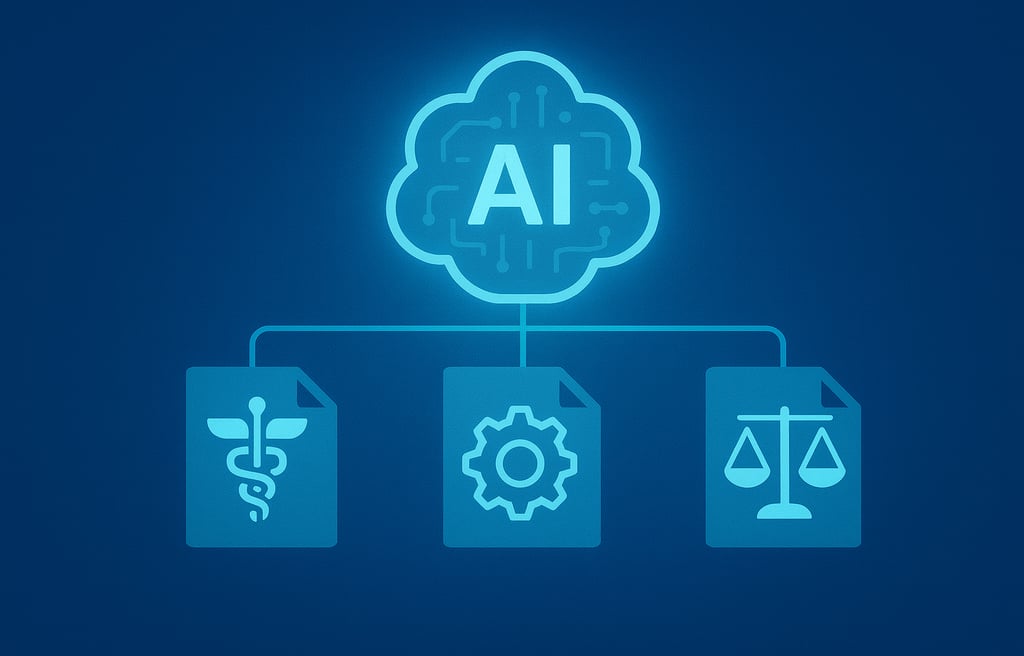
The future isn't about choosing between general and domain-specific models—it's about using both strategically. Many organizations are adopting hybrid architectures where general LLMs handle broad tasks while domain-specific models tackle specialized work requiring deep expertise.
We're also seeing the emergence of efficient adaptation techniques like Low-Rank Adaptation (LoRA) and prompt engineering strategies that allow organizations to customize general models without full retraining. These approaches offer middle-ground solutions, providing domain specialization with lower resource requirements.
As AI continues its rapid evolution, the organizations finding greatest success are those that recognize when general capabilities suffice and when specialized expertise is non-negotiable. Domain-specific LLMs represent not a rejection of general models' power, but a mature acknowledgment that different problems require different tools—and that sometimes, focused expertise beats broad capability.