Designing Your 2025 AI Roadmap
Most AI roadmaps fail by falling into two traps: analysis paralysis or chaotic experimentation. Learn how to design a 2025 roadmap that selects 3-5 high-value LLM initiatives, aligns them with your actual infrastructure and governance maturity, and avoids both "do nothing" delays and unfocused AI land-grabs.
12/30/20244 min read
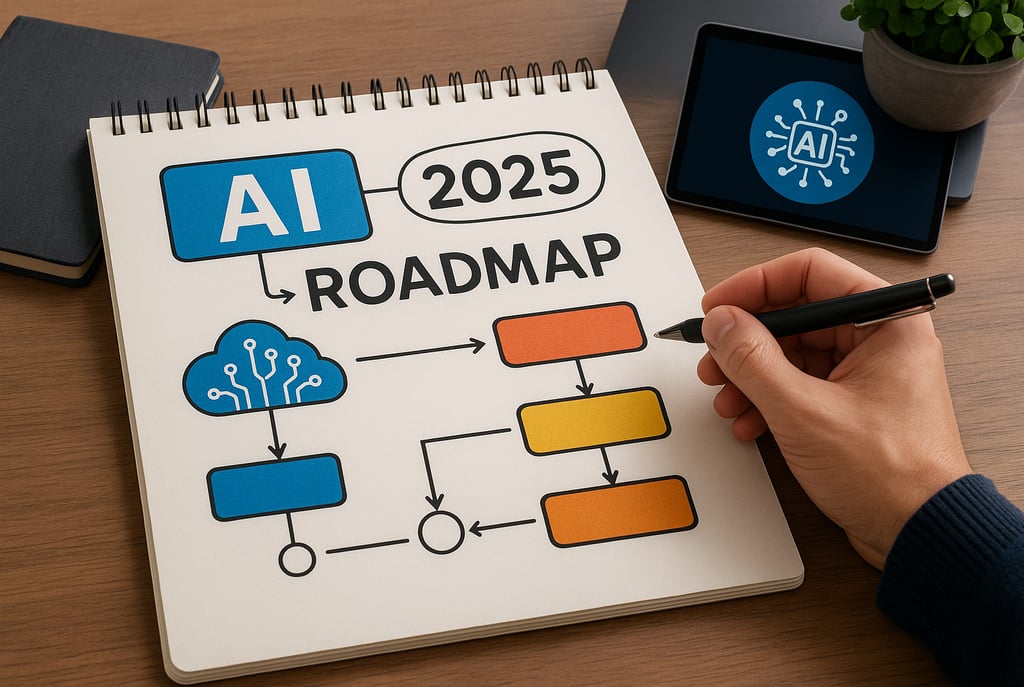

As we close out 2024 and prepare for the year ahead, enterprise leaders face a familiar tension: the gap between AI's promise and its practical implementation. Recent data reveals that only one in five AI initiatives achieve ROI, and just one in fifty deliver true transformation. The challenge isn't technology availability—it's strategic clarity.
The path forward demands more than enthusiasm. It requires a pragmatic roadmap that balances ambition with execution, aligning LLM initiatives with your organization's actual maturity level rather than aspirational headlines.
The Paralysis-Land Grab Spectrum
Organizations typically fall into two traps. The first is "analysis paralysis"—endless strategic discussions while competitors ship working solutions. These teams obsess over perfect governance frameworks before testing a single use case, effectively deciding not to decide.
The opposite extreme is the AI land grab: departmental teams spinning up shadow LLM implementations, each burning budget on overlapping vendor relationships without enterprise coordination. When every team pursues their own ChatGPT integration, you end up with fragmented data governance, duplicated costs, and compliance nightmares.
Both extremes stem from the same root cause: lack of a structured, maturity-aligned roadmap.
Start With Honest Assessment
Before selecting initiatives, conduct a clear-eyed assessment across four dimensions. Data quality and accessibility form the foundation—assess whether your data is clean, trustworthy, and available without bureaucratic barriers. Many organizations overestimate their data readiness only to discover siloed databases and inconsistent formats during implementation.
Evaluate your technical infrastructure honestly. Do you have the platforms, MLOps pipelines, and compute resources to support LLM deployment at scale? Your current cloud environment and integration capabilities will constrain what's realistic in 2025.
Assess your people and culture. Organizations typically start by establishing a community of practice that brings together stakeholders interested in AI and/or dedicated AI teams to focus on a limited set of high-priority activities. Do you have the talent, training programs, and executive sponsorship to sustain momentum?
Finally, examine your governance maturity. Organizations need defined roles, workflows, and risk thresholds for LLM deployments to move from pilot to production without roadblocks. Without established policies around data privacy, model transparency, and accountability, even successful pilots will stall.
The 3-5 Initiative Framework
Armed with this assessment, apply a disciplined selection process. Research consistently shows that teams should identify 3-5 initial use cases and select 1-2 for pilot implementation. This focused approach prevents resource fragmentation while maintaining momentum.
Select initiatives using three filters simultaneously. First, business impact: which use cases directly address strategic priorities with measurable outcomes? Second, technical feasibility: given your infrastructure and data maturity, what's actually achievable in a 6-12 month timeframe? Third, organizational readiness: which departments have the change management capacity and stakeholder buy-in to adopt new AI-powered workflows?
The sweet spot lies where all three intersect. A customer service chatbot might score high on impact and feasibility but fail if your support team resists change. Conversely, an exciting internal productivity tool might have departmental champions but lack executive-level impact justification.
Prioritize quick wins with strategic value. The ideal pilot balances quick wins with strategic value. Your first initiative should demonstrate tangible results within 90 days while building capabilities for more ambitious projects. Think contract analysis tools that save legal teams hundreds of hours, not multi-year digital transformation programs.
Align Infrastructure and Governance in Parallel
Here's where most roadmaps fail: treating infrastructure and governance as sequential phases rather than parallel workstreams. Your 2025 roadmap must develop both simultaneously, scaled to your maturity level.
For organizations in early stages, this means establishing basic data governance policies alongside your first pilot. Governance ensures that only legally sourced, representative, and high-quality datasets are used for training and fine-tuning. You don't need enterprise-wide AI ethics committees on day one, but you do need clear guidelines for which data can be used and how to handle sensitive information.
As initiatives scale, governance must evolve from reactive policies to proactive frameworks. Continuous monitoring and auditing is essential so that models continue to perform as intended throughout their lifecycle. Mature organizations embed privacy protection, fairness checks, and security protocols into every stage of the model lifecycle.
Infrastructure scaling follows a similar pattern. Start with vendor-managed solutions that minimize operational overhead. Many fintech startups frequently begin with proprietary models for ease of deployment before transitioning to open-source alternatives as internal AI expertise and infrastructure expand. As your team gains experience, you can justify investment in custom infrastructure and specialized compute resources.
Build Your 2025 Timeline
Structure your roadmap in deliberate phases. Q1 should focus on foundation-building: finalize your 3-5 priority initiatives, establish baseline governance policies, and launch 1-2 pilots. Resist the temptation to simultaneously pursue everything—disciplined focus now prevents chaos later.
Q2 transitions from pilots to production. Evaluate initial results, refine based on real-world feedback, and begin scaling successful use cases. This is when governance frameworks prove their value. Organizations with clear policies can accelerate; those without hit compliance roadblocks.
Q3 and Q4 are for expanding impact. With proven pilots and established governance, you can confidently pursue additional use cases. Organizations must consider continuous monitoring of usage and ROI, establishing key metrics that measure the success of AI adoption. This iterative approach—pilot, evaluate, scale, repeat—builds sustainable momentum.
Navigate the Middle Path
The most successful 2025 AI roadmaps will be those that resist extremes. Not the perfectionist paralysis of endless planning, nor the chaotic land grab of uncoordinated experimentation. Instead, they'll reflect a disciplined middle path: focused initiative selection, honest maturity assessment, parallel development of capabilities and guardrails.
Your competitors are making their decisions now. Some will achieve transformational results. Others will become cautionary tales of wasted investment. The difference comes down to strategic clarity—knowing exactly which 3-5 initiatives align with your infrastructure, governance maturity, and organizational readiness.
The question for 2025 isn't whether to pursue AI, but which specific initiatives to pursue, in what sequence, and with what supporting infrastructure. Answer those questions with rigorous honesty, and you'll join the organizations turning AI potential into measurable business value.