Decomposing Complex Tasks
Learn how to build reliable AI systems by breaking complex tasks into multi-step prompt pipelines. Master the plan-generate-refine-verify pattern, understand different orchestration structures, and discover where to strategically insert human review checkpoints. Transform unreliable single-shot prompts into robust, production-ready workflows that handle real-world complexity.
5/6/20243 min read
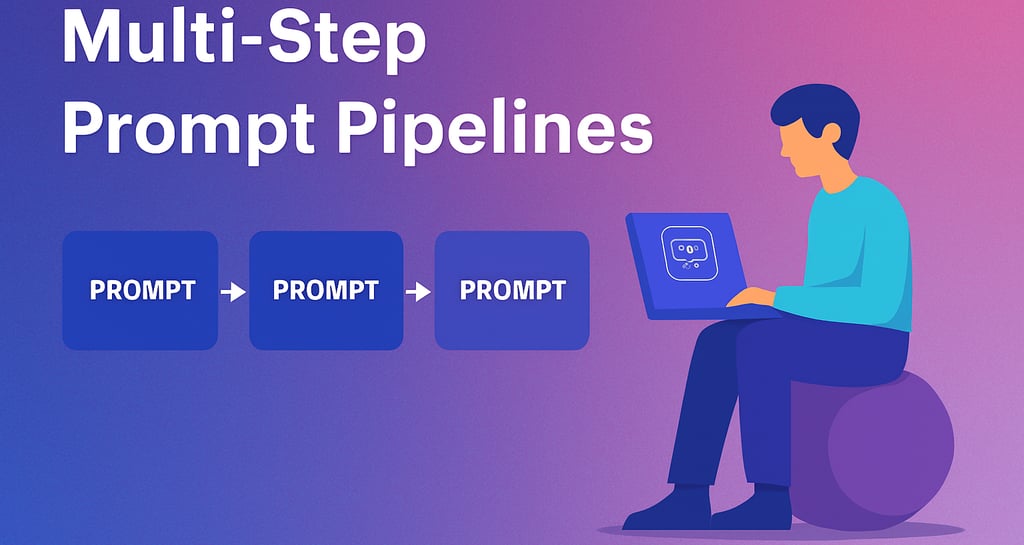
Ask a language model to perform a complex task in a single prompt, and you're setting yourself up for disappointment. The output might be inconsistent, incomplete, or entirely off-track. Professional AI systems don't try to do everything at once—they break complex tasks into carefully orchestrated sequences of smaller, focused steps. This approach, called multi-step prompt pipelines, is how you build reliable AI workflows that handle real-world complexity.
Why Single-Shot Prompts Fail at Complexity
Imagine asking an AI to "analyze these 50 customer reviews, identify common themes, prioritize them by business impact, generate improvement recommendations, and draft an executive summary." That's actually five distinct cognitive tasks crammed into one request. The model must simultaneously analyze, synthesize, evaluate, create, and summarize—all while maintaining context and consistency.
The result? The AI might skip important themes, confuse prioritization with frequency, generate generic recommendations, or produce an unfocused summary. The cognitive load is simply too high for reliable execution in a single pass.
The Pipeline Approach: Divide and Conquer
Multi-step pipelines decompose complex tasks into sequential stages, where each stage has a clear, focused objective. The output from one stage becomes input for the next, creating a chain of specialized operations.
Our customer review analysis becomes a four-stage pipeline:
Stage 1 - Theme Extraction: Analyze the reviews and extract distinct themes. Output: structured list of themes with supporting quotes.
Stage 2 - Impact Assessment: Evaluate each theme's business impact based on frequency, severity, and revenue implications. Output: ranked themes with impact scores.
Stage 3 - Recommendation Generation: For top-priority themes, generate specific, actionable recommendations. Output: detailed improvement proposals.
Stage 4 - Executive Summary: Synthesize findings into a concise executive briefing. Output: polished summary document.
Each stage is manageable, testable, and can be optimized independently.
The Plan → Generate → Refine → Verify Pattern
One of the most powerful pipeline structures follows a four-phase pattern that mirrors how humans approach complex creative work:
Plan Phase: The AI creates a structured outline or approach before diving into execution. For a research report, this means generating section headers, key questions to address, and the logical flow.
Create a detailed outline for a report on [topic]:
- Identify 5-7 main sections
- For each section, list 3-4 key points to cover
- Suggest data or evidence needed for each point
Output the outline as a structured plan.
Generate Phase: Using the plan as scaffolding, the AI produces the actual content. Crucially, the plan constrains and guides generation, preventing drift.
Using this outline: {plan}
Write the content for Section 1: {section_title}
Follow the key points specified in the plan.
Length: approximately 300 words.
Refine Phase: A separate prompt reviews and improves the generated content, looking for issues the generation phase might have missed.
Review this content for:
- Clarity and conciseness
- Logical flow between paragraphs
- Consistency with the overall plan
- Opportunities to strengthen arguments
Provide the improved version.
Verify Phase: A final quality check ensures the output meets requirements before delivery.
Verify this final content:
- Are all planned sections complete?
- Does it meet the specified length?
- Is the tone appropriate for {audience}?
- Are there any factual inconsistencies?
Output: JSON with {"passes_verification": boolean, "issues": [list of any problems]}
Orchestration Patterns
Different tasks require different pipeline structures. Here are common patterns:
Linear Pipeline: Each stage depends strictly on the previous stage's output. Simple and predictable, ideal for workflows like document generation or data processing.
Branching Pipeline: One stage's output feeds multiple parallel stages, then results merge. Perfect for analysis tasks: extract data once, then run multiple types of analysis simultaneously.
Iterative Pipeline: Output loops back for refinement until quality criteria are met. Essential for creative tasks or optimization problems where the first attempt rarely satisfies requirements.
Conditional Pipeline: Later stages execute only if earlier stages meet certain criteria. Critical for workflows involving validation or approval gates.
Where to Insert Human Review
Not every stage needs human oversight, but strategic human-in-the-loop checkpoints dramatically improve reliability:
High-stakes decisions: Before the AI makes irreversible actions (sending emails, processing refunds, deleting data), require human approval.
Quality gates: After major generative stages, allow human review before proceeding. For a blog post pipeline, review the outline before generating full content.
Error correction: When the AI reports low confidence or encounters ambiguous inputs, pause for human clarification rather than guessing.
Final approval: Always allow human review of final outputs before delivery, especially for customer-facing content or business decisions.
Implementation example:
def content_pipeline(topic):
outline = generate_outline(topic)
# Human review checkpoint
if not human_approves(outline):
outline = human_edits(outline)
content = generate_content(outline)
refined = refine_content(content)
# Final approval checkpoint
if human_approves(refined):
return publish(refined)
else:
return request_revisions(refined)
Pipeline Benefits Beyond Accuracy
Multi-step pipelines offer advantages beyond improved output quality. Each stage is independently testable—you can verify theme extraction works before building recommendation generation. Debugging becomes surgical: when output fails, you know exactly which stage broke.
Pipelines also enable partial caching. If stage one (expensive data processing) succeeds but stage three fails, you can retry from stage three without reprocessing everything. This saves time and API costs.
Building Robust Workflows
Complex tasks demand complex solutions, but complexity doesn't mean chaos. Multi-step prompt pipelines bring structure, reliability, and human oversight to AI workflows. By decomposing problems into manageable stages and orchestrating them thoughtfully, you transform unreliable single-shot prompts into robust, production-ready systems that handle real-world complexity with confidence.