Creative Work with AI: From Prompting to Co-Direction
Creative professionals are moving beyond simple AI prompts toward genuine collaboration. Through iterative briefs, style steering, and thoughtfully designed workflows, designers, writers, and creators are learning to work with AI as a creative partner rather than a vending machine—preserving human voice while expanding creative possibilities.
9/15/20253 min read
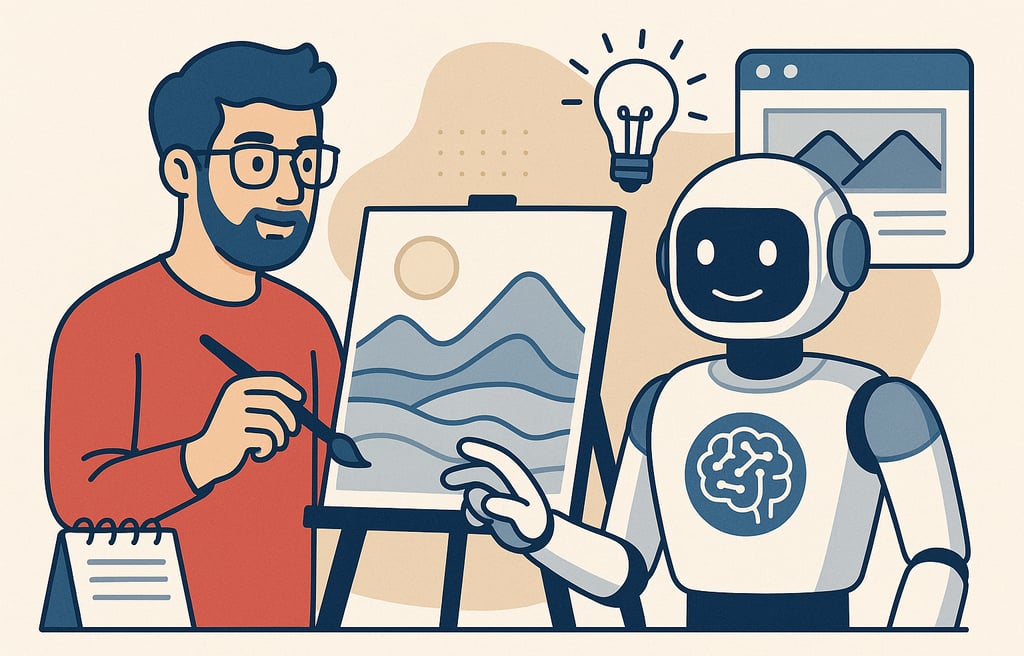
The first wave of AI-assisted creativity looked something like this: a designer types "create a logo for a coffee shop," reviews ten generic options, picks one, and calls it done. A writer asks for "five headline variations," chooses the least awkward, and moves on. This transactional approach—what we might call "vending machine creativity"—treated AI as a bulk generator rather than a collaborative partner.
But throughout 2024 and into 2025, something fundamental has shifted. Creative professionals are discovering that the real power of AI tools isn't in their ability to produce finished work at scale, but in their capacity to engage in genuine creative dialogue.
The Evolution of the Creative Brief
The transformation begins with how creators frame their requests. Early adopters quickly learned that specificity matters, but the sophistication goes deeper than detailed prompts. Today's creative professionals are treating AI conversations like they would a discussion with a junior collaborator—providing context, sharing references, and most importantly, iterating based on what emerges.
"I don't ask for finished concepts anymore," explains Maria Chen, a brand designer in Singapore. "I start by describing the emotional territory I'm exploring. Then I'll ask the AI to help me think through different approaches. It's become this back-and-forth where each exchange sharpens my own thinking."
This iterative approach mirrors traditional creative partnerships. A film director doesn't hand a cinematographer a single instruction and walk away. Instead, they engage in ongoing dialogue, refining the vision through multiple touchpoints. AI tools, when used thoughtfully, can now participate in similar exchanges.
Style Steering and Voice Preservation
Perhaps the most significant development is the emergence of what practitioners call "style steering"—the ability to guide AI outputs while maintaining a distinctive creative voice. This goes far beyond feeding examples into a system. It involves developing an intuition for how different instructions shape tone, structure, and aesthetic choices.
Writers are building personal style guides within their AI workflows, documenting not just what works but why certain approaches produce results that feel authentically theirs. Some maintain "voice journals" where they track successful prompts alongside reflections on what made the output feel right or wrong.
Graphic designers are taking similar approaches with visual work, creating libraries of stylistic anchors—color palettes, compositional principles, and reference points that help steer generative tools toward outcomes that align with their artistic sensibilities. The goal isn't to eliminate the AI's contribution but to channel it through a distinctly human aesthetic filter.
Workflows That Center Human Judgment
The most effective creative workflows now position AI as one tool among many, integrated into processes where human judgment remains central. Rather than replacing traditional creative methods, AI augments them.
Documentary filmmaker James Okafor describes his current process: "I'll use AI to rapidly prototype different narrative structures for a piece. But then I step away from the screen entirely. I print things out, I sketch, I talk with collaborators. The AI helps me explore possibilities faster, but the crucial decisions happen in spaces where I'm thinking slowly and carefully."
This intentional separation—using AI for exploration while reserving other spaces for reflection and refinement—appears across disciplines. Copywriters generate variations quickly but return to pen and paper for final polish. Product designers use AI for concept exploration but rely on physical prototyping for validation.
The Emerging Toolkit
As these practices mature, a new category of tools is emerging specifically designed for creative co-direction rather than simple generation. These platforms emphasize version control, allowing creators to branch explorations without losing promising directions. They incorporate feedback loops where creators can mark what works and what doesn't, gradually teaching systems to understand individual preferences.
Some tools now offer "creative diff" views—showing not just the output but highlighting where AI suggestions diverge from a creator's established patterns, making it easier to evaluate whether innovations enhance or dilute a distinctive voice.
The Path Forward
This evolution from prompting to co-direction represents a maturation in how creative professionals engage with AI. Rather than viewing these tools as shortcuts or threats, practitioners are discovering their value as thought partners—systems that can help explore creative territories more thoroughly while leaving the final navigation firmly in human hands.
The question is no longer whether AI has a place in creative work. Instead, it's about developing the skills and workflows that let us collaborate with these systems without surrendering what makes creative work human: judgment, taste, and the willingness to follow unexpected inspirations toward something genuinely new.