Collaborative AI: Designing Multi-User, Multi-AI Workflows
Collaborative AI is transforming how teams work. Moving beyond one-on-one chatbots, organizations are building multi-user workflows with shared AI threads, AI-generated first drafts that teams edit together, and intelligent agents that coordinate across roles and systems—creating integrated human-AI teams that work smarter together.
7/7/20254 min read
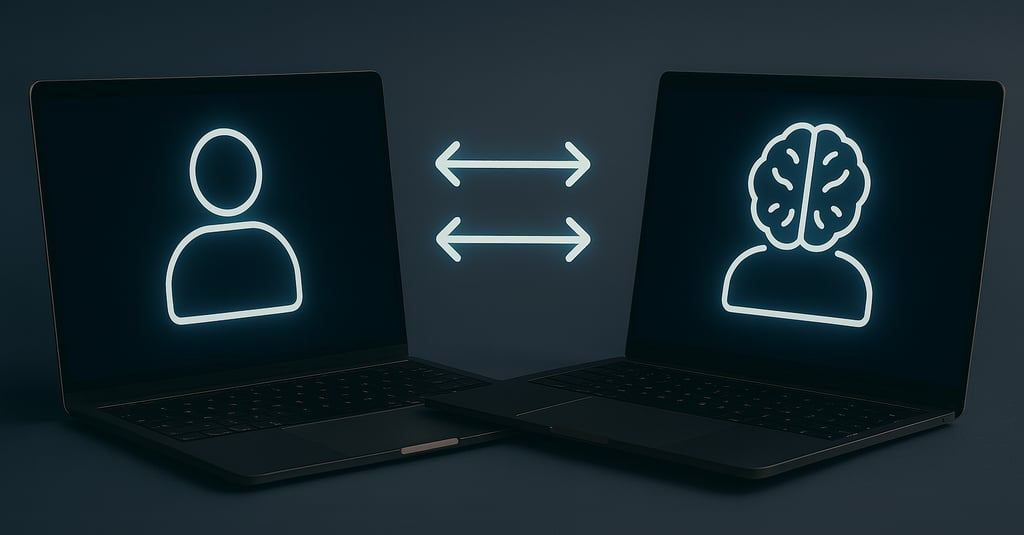
The era of AI as a solitary assistant is ending. While we've grown accustomed to one-on-one conversations with chatbots, the future of artificial intelligence in the workplace looks radically different: collaborative, interconnected, and designed for teams rather than individuals. As organizations race to integrate AI into their operations, a fundamental shift is underway—from isolated AI interactions to sophisticated multi-user, multi-AI workflows that mirror how teams actually work.
Beyond the Chat Box: AI in Team Contexts
Teams are increasingly using AI through shared channels and collaborative spaces where multiple people can interact with the same AI conversation thread. Rather than each team member maintaining separate conversations with an AI assistant, organizations are discovering the power of shared AI threads—persistent workspaces where context accumulates, decisions are documented, and everyone stays aligned.
Modern collaborative editing platforms enable teams to create comment threads, use mentions to assign feedback, and see real-time indicators when colleagues are actively working on content. This represents a fundamental departure from traditional AI workflows. When a marketing team brainstorms campaign concepts, the AI doesn't just respond to one person's prompt—it becomes a participant in an ongoing team dialogue, building on previous contributions and maintaining continuity across multiple sessions and contributors.
These shared workspaces solve a critical problem: the fragmentation that occurs when team members work with AI in isolation. Ideas get duplicated, context gets lost, and the collective intelligence of both human and artificial collaborators fails to compound. Shared AI threads create institutional memory, transforming ephemeral interactions into permanent knowledge assets.
The First Draft Revolution
Perhaps the most transformative pattern emerging in collaborative AI is the "first draft" approach. Rather than producing final deliverables, AI generates comprehensive starting points that multiple team members can then refine, critique, and enhance. This inverts the traditional creative process.
AI tools now create project outlines, generate summaries from multiple sources, and produce initial document drafts that teams can collectively edit with real-time collaboration features. A legal team might have AI draft a contract based on previous agreements, then have multiple attorneys simultaneously review different sections, adding their specialized knowledge. A product team could generate feature specifications through AI, then coordinate refinements across design, engineering, and business stakeholders—all working in the same document.
This approach dramatically accelerates workflows while maintaining human judgment at the center. The AI handles the blank page problem and synthesizes information from disparate sources, but humans provide the critical thinking, strategic direction, and final polish. Teams report significant time savings not from AI replacing human work, but from AI eliminating the most time-consuming preliminary stages.
Multi-Agent Orchestration: The New Frontier
The most sophisticated development in collaborative AI involves multiple AI agents coordinating with each other across roles and tools. AI agent orchestration acts as a conductor, coordinating multiple specialized agents so they can collaborate, share context, and execute complex tasks across different systems.
Consider an employee onboarding process: An HR agent creates the employee profile and triggers downstream tasks, an IT agent provisions access to necessary systems, and a facilities agent handles workspace preparation—all coordinated automatically. Each agent specializes in its domain but communicates with others to ensure seamless execution.
In customer service automation, an orchestrator determines whether to engage a billing agent versus a technical support agent, ensuring customers receive seamless and relevant assistance. This multi-agent approach extends beyond simple automation. The agents don't just follow rigid scripts—they make contextual decisions, adapt to changing circumstances, and coordinate handoffs based on the specific situation.
AI agents can understand goals, break them into subtasks, interact with both humans and systems, execute actions, and adapt in real time with minimal human intervention. This enables agents to function as proactive teammates rather than passive tools, monitoring dashboards, triggering workflows, and following up on tasks without constant human direction.
Designing for Collaboration
Building effective multi-user, multi-AI workflows requires intentional design choices. Organizations are implementing multi-agent orchestration with natural-language interfaces, enabling agents to proactively recommend actions throughout workflows and automatically identify needs for follow-up tasks.
The technical architecture matters enormously. Multi-agent orchestration manages how individual agents are assigned tasks, share data, and communicate in real time, directing agents to collaborate, exchange context, and adapt based on changing conditions. This coordination layer ensures smooth handoffs, conflict resolution, and consistent execution across all agents.
But technology alone doesn't determine success. Organizations must rethink performance management systems to track how well people orchestrate agents, unlock value, and deliver outcomes rather than just tracking task completion. New roles are emerging: broad generalists who orchestrate agents across domains, deep specialists who handle complex edge cases where agents fail, and human supervisors who maintain oversight of automated workflows.
The Path Forward
As collaborative AI matures, organizations face both tremendous opportunities and significant challenges. The real challenge lies in coordination, judgment, and trust—determining when agents should take initiative versus when they should defer, and maintaining human agency without slowing down the benefits agents bring.
Agentic AI cuts across organizational boundaries, requiring IT expertise for deployment, HR-like frameworks for performance management, financial models for investment, legal oversight for autonomous decisions, and business unit coordination for workflow integration. Successfully implementing collaborative AI demands executive collaboration that transcends traditional departmental silos.
The organizations that will thrive in this new paradigm aren't necessarily those with the most advanced AI technology. They're the ones that successfully redesign workflows around collaborative human-AI teams, establish clear governance frameworks, and cultivate cultures where humans and agents work together effectively. The future of work isn't about AI replacing humans or humans managing AI—it's about designing systems where multiple humans and multiple AI agents collaborate as integrated teams, each contributing their unique strengths to achieve outcomes neither could accomplish alone.