Can ChatGPT Replace Google?
This blog compares ChatGPT-style chatbots with traditional search engines, explaining why they excel at different things. It shows when to use a conversational AI for explanations, drafting, and rewriting, and when to rely on Google for fresh information, official sources, and comparisons—arguing that the future isn’t “ChatGPT vs. Google,” but using both together for better answers and decisions.
2/20/20232 min read
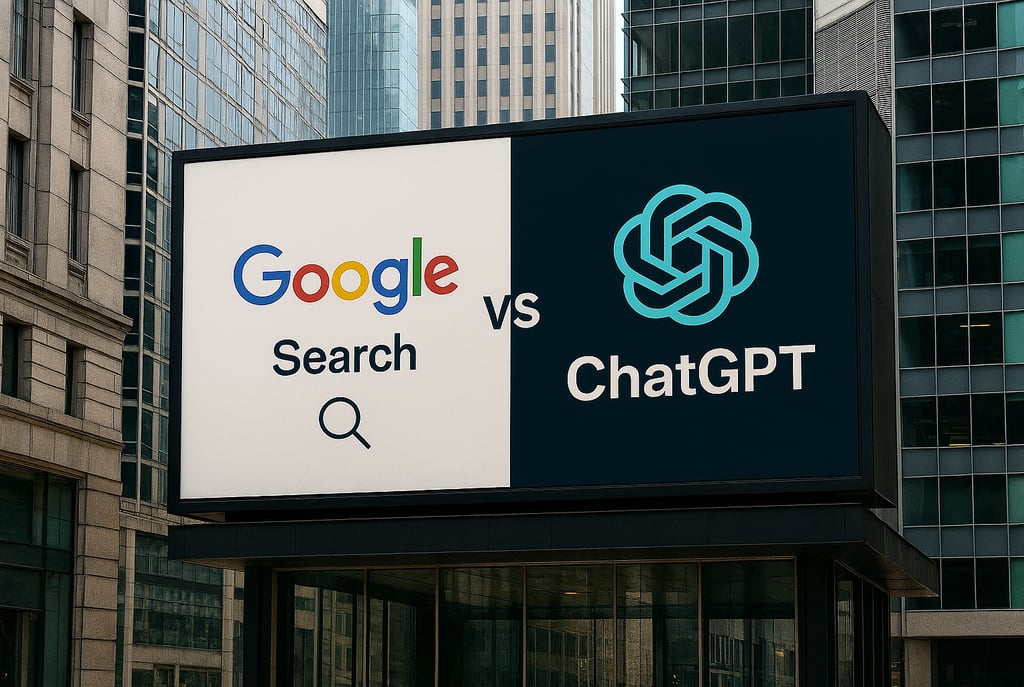
Since ChatGPT exploded into public view, one question keeps coming up: “Is this the end of Google?” On the surface, both tools answer questions you type into a box. But under the hood—and in how you should use them—they’re very different. Rather than thinking in terms of “replacement,” it’s more useful to ask: When should I use a chatbot, and when is a classic search engine still the better choice?
What Google (and Search Engines) Are Good At
Search engines are built to find web pages, not to talk. Their strengths are:
Fresh, live information
Want today’s news, stock prices, game scores, flight status, or a product that just launched? A search engine is connected to the live web. ChatGPT-style models are trained on past data and don’t automatically know what changed yesterday.Official and authoritative sources
Need the actual government website for visa rules, the original research paper, a product manual, or your bank’s official page? Search gets you to the source so you can see the information in its original context.Comparisons and options
Looking for “best noise-cancelling headphones” or “restaurants near me”? Search shines when you want lists, reviews, and choices, not just one synthesized answer.
In short, search is like a map of the web: it points you to places where the information lives and lets you judge what to trust.
What ChatGPT (and LLMs) Are Good At
ChatGPT is built to generate text, not index web pages. Its strengths are different:
Explanations and learning
“Explain quantum computing like I’m 12.”
“Teach me the basics of Kubernetes.”
“Compare HTTP and WebSockets in simple terms.”
ChatGPT is great when you want concepts explained at your level, with examples and follow-up questions.Summarization and rewriting
Paste a long email, article, or draft and ask it to:Summarize
Make it clearer
Change the tone
Turn it into bullet points
This isn’t search; it’s text transformation.
Creating first drafts
Emails, blog outlines, job descriptions, interview questions, lesson plans, even bits of code—ChatGPT can give you a structured first pass that you then edit.Interactive problem solving
You can say: “That’s not what I meant. Try a more formal tone,” or “Add a section about risks,” and it adjusts. This conversational loop is its superpower.
Think of ChatGPT less as an encyclopedia and more as a writing, thinking, and tutoring assistant.
Where ChatGPT Falls Short
Despite the hype, ChatGPT has real limitations:
It can hallucinate—confidently give you wrong facts or made-up sources.
Its knowledge is not live; it doesn’t automatically know about the latest events, prices, or changes.
It doesn’t show you multiple external sources by default, so you can’t easily check where an answer came from.
That’s why for anything high-stakes or time-sensitive, you should verify with search or official sites.
So… Can ChatGPT Replace Google?
For most people, the honest answer is no—but it can replace a lot of what you used Google for.
Use ChatGPT when you:
Want something explained, simplified, or taught
Need a draft, outline, or rewrite
Want help with wording, structure, or ideas
Need to reason through a problem step by step
Use Google (or classic search) when you:
Need up-to-date information, news, or prices
Need official sources, policies, or documentation
Want to compare options, reviews, or products
Need to check whether something is actually true
The smart move isn’t to choose one “winner,” but to combine both:
Ask ChatGPT to explain, summarize, or draft—then use search to verify facts, find sources, and explore alternatives.
In other words, ChatGPT isn’t Google’s replacement; it’s becoming the natural-language front end to how we think, write, and learn—while search remains the backbone of how we reach the wider web.