AI Workflow Engines, From Single Prompts to End-to-End Automated Flows
Discover how AI workflow engines are transforming single LLM prompts into sophisticated automated systems. Learn about multi-step pipelines, human-in-the-loop checkpoints, conditional branching logic, and practical strategies for replacing brittle scripts with maintainable, enterprise-ready AI flows that combine machine efficiency with human oversight.
3/3/20254 min read
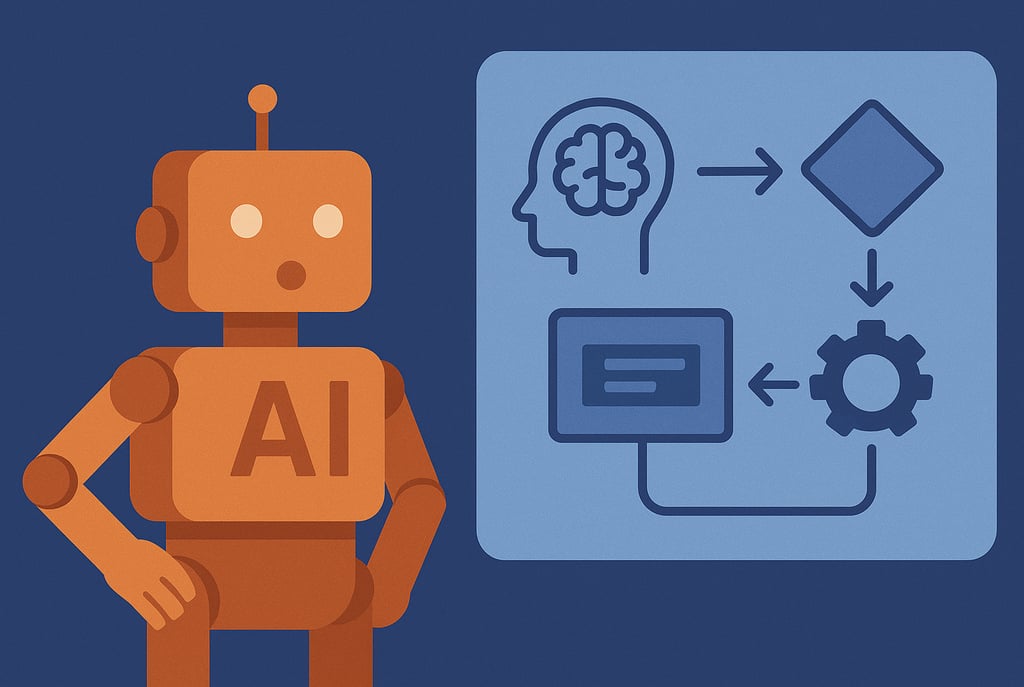
The age of one-off AI prompts is rapidly giving way to something far more powerful: intelligent workflow engines that orchestrate complex, multi-step processes. As organizations move beyond experimental AI implementations, they're discovering that true business value comes not from isolated LLM calls, but from coordinated sequences of AI-powered tasks that can handle sophisticated logic, adapt to changing conditions, and incorporate human judgment at critical moments.
The Evolution from Scripts to Flows
In the early days of LLM adoption, teams typically built simple scripts: send a prompt, receive a response, maybe chain a few calls together. These approaches worked for proof-of-concept projects but quickly revealed their limitations. Scripts became brittle as complexity grew. Error handling was an afterthought. When requirements changed, developers faced cascading rewrites across tightly coupled code. The result was a maintenance nightmare that couldn't scale with business needs.
Modern workflow engines like Dify and Flowise offer visual, drag-and-drop interfaces for building AI applications, allowing both technical and non-technical users to create sophisticated automation. These platforms emphasize flexibility, visibility into AI decision-making processes, and the ability to maintain control over agent behavior. The shift represents moving from imperative "do this, then this" coding to declarative "here's what should happen" orchestration.
Multi-Step Pipelines: Building Complex Workflows
At the heart of these engines lies the ability to chain together multiple operations into coherent pipelines. Unlike simple sequential scripts, workflow pipelines support sophisticated patterns. Conditional edges enable dynamic branching where different execution paths are taken based on runtime conditions, allowing workflows to adapt intelligently to the data they process.
Consider a content moderation workflow: an initial LLM call might classify incoming content by type and risk level. Based on that classification, the workflow routes to specialized processors—one branch for text analysis, another for image recognition, a third for legal review. Each branch can invoke different models, call external APIs, or trigger database operations. This routing pattern enables specialization where each sub-workflow can be optimized without affecting others.
Platforms like LangChain offer composable pipelines that chain multiple LLM calls and external functions together, while maintaining memory management for conversational context. This architectural approach transforms brittle scripts into maintainable systems where individual components can be tested, monitored, and upgraded independently.
Human-in-the-Loop: The Critical Safety Net
Despite AI's impressive capabilities, fully autonomous systems remain inappropriate for high-stakes decisions. Human-in-the-loop workflows integrate human judgment and oversight at critical stages, ensuring AI outputs align with human values and business requirements. This isn't about distrust of AI—it's about combining machine efficiency with human wisdom.
HITL workflows route uncertain or high-stakes decisions to human experts through deliberate orchestration that defines when and how AI delegates to humans. Modern implementations use confidence thresholds: when an AI model's certainty falls below a defined level, the workflow pauses and queues the decision for human review. These workflows must manage state for hours, days, or even weeks while awaiting human input, requiring persistent storage and robust state management.
The benefits extend beyond safety. By keeping humans in the loop, organizations ensure AI augments rather than replaces human expertise and creativity. In practice, this means AI handles high-volume routine cases at speed while humans focus on exceptions, edge cases, and decisions requiring nuanced judgment. A well-designed HITL system makes operations smarter by combining speed with quality control, reducing total workload without sacrificing accuracy.
Branching Logic: Making Workflows Intelligent
True workflow intelligence requires the ability to make decisions and adapt paths dynamically. Modern workflow builders support conditional logic with "and" and "or" operators, fallback paths for handling unexpected data, and nested paths that can branch three levels deep. This flexibility enables workflows to handle real-world complexity.
Branching isn't just about binary decisions. Advanced implementations allow workflows to trigger multiple parallel operations based on data characteristics—one email might simultaneously archive to storage, route to a reply assistant, and trigger analytics processing. Each branch can have its own set of conditions, timeout rules, and error handling strategies.
Enterprise workflow platforms now support if/else condition task types and dynamic runtime values, enabling sophisticated use cases like running additional processing steps on weekends or excluding tasks when no new data appears. The key is making these complex decision trees visible, debuggable, and maintainable—something visual workflow builders excel at compared to nested code logic.
From Brittle Scripts to Maintainable Systems
The transformation from scripts to workflows addresses fundamental engineering challenges. Scripts typically embed logic, data, and execution together in ways that resist change. Workflows separate these concerns: logic becomes visual flow diagrams, data passes between well-defined steps, and execution gets managed by the orchestration engine.
This separation enables several critical capabilities. Teams can version control workflow definitions independently of the underlying code. Changes can be tested in isolation before deployment. Modern workflow engines position themselves as "agent orchestrators" with specific features for LLM workflow management, state management patterns, and conversation handling. Monitoring becomes straightforward when each step reports metrics and logs to a central system.
Error handling, often an afterthought in scripts, becomes first-class in workflow engines. Failed steps can retry with exponential backoff, route to alternative paths, or escalate to human operators. Production workflows implement error catching, self-healing flows, audit trails, and real-time dashboards that give operators visibility into what's happening and where problems occur.
The Future of AI Orchestration
As AI capabilities continue advancing, workflow engines will play an increasingly vital role. They provide the structure needed to make AI systems reliable, auditable, and maintainable at enterprise scale. The most successful implementations will balance autonomy with oversight, leveraging AI's speed and consistency while preserving human judgment for decisions that require it.
Real-world examples like Recursion's LOWE system demonstrate how LLM-orchestrated workflow engines can streamline complex multi-step processes, making cutting-edge AI accessible to domain experts without machine learning backgrounds. This democratization—making powerful AI workflows available through intuitive interfaces rather than requiring deep technical expertise—represents the technology's most transformative potential.
The shift from single prompts to end-to-end automated flows isn't just about technical capability. It's about making AI practical for real business processes that require reliability, maintainability, and the ability to evolve with changing requirements. Workflow engines provide the foundation for that transition, turning experimental AI projects into production systems that deliver lasting value.