AI Maturity Models: Assessing Where You Are and What to Do Next
Understanding your organization's AI maturity isn't about judgment—it's about clarity. This guide walks through the five-stage AI maturity ladder and provides practical frameworks for honest self-assessment. Learn how to identify your current position and choose the highest-leverage next moves, whether you're just experimenting or building AI-native operations.
7/21/20253 min read
Every organization I speak with has an AI story. Some are running pilot projects that never quite made it to production. Others have scattered initiatives across departments with no central coordination. A few have transformed their entire operating model around AI capabilities. The difference between these scenarios isn't luck—it's maturity.
Understanding where you sit on the AI maturity spectrum isn't about judgment; it's about clarity. And clarity is what enables you to make the right next moves rather than chasing every new model release or burning budget on initiatives that go nowhere.
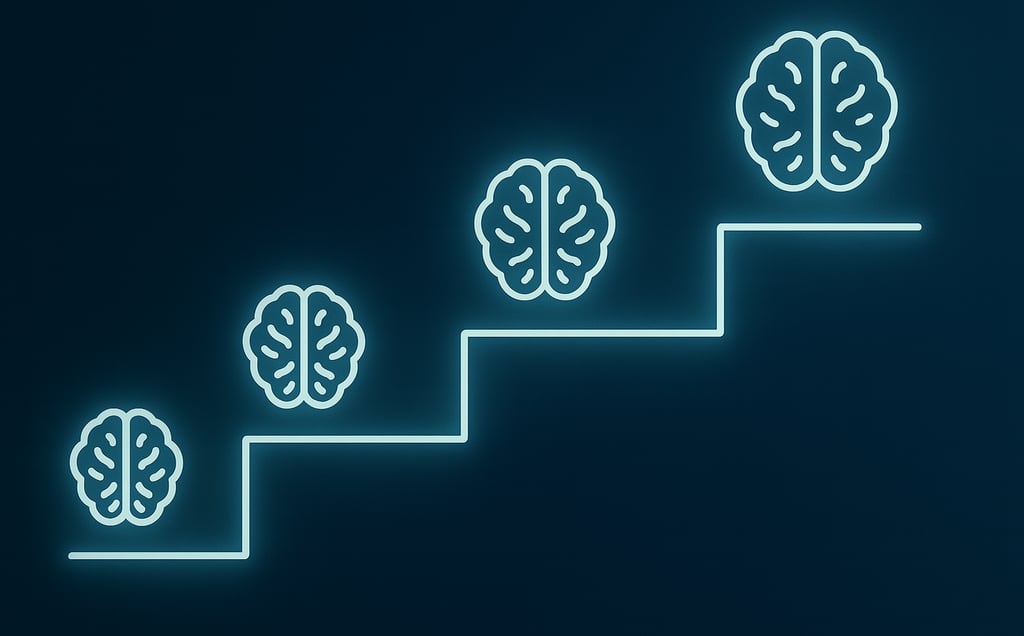
The Five-Stage Maturity Ladder
Most organizations progress through five distinct stages of AI maturity, each with its own characteristics and challenges:
Stage 1: Awareness – Conversations about AI are happening, but they're unfocused. There's excitement, maybe some anxiety, but no concrete experiments. Leadership asks questions like "Should we be doing something with AI?" without clear answers.
Stage 2: Experimentation – Proofs of concept appear. Teams test AI tools for specific use cases. There's enthusiasm but also chaos—different departments may be trying similar things without knowing it. No standardization exists, and most pilots don't scale.
Stage 3: Operational – At least one AI initiative has reached production. You have an executive sponsor, a dedicated budget, and emerging best practices. AI expertise becomes accessible across the enterprise, though still concentrated in pockets.
Stage 4: Systematic – AI consideration becomes standard in every new digital project. Your products and services increasingly embed AI capabilities. You have established governance frameworks, clear data strategies, and cross-functional AI literacy.
Stage 5: Transformative – AI isn't just embedded in processes; it fundamentally shapes your business model. Every team member understands both AI's strengths and limitations. You may be developing custom models or pioneering novel applications in your industry.
Honest Assessment: Where Are You Really?
The hardest part of maturity assessment isn't understanding the framework—it's being brutally honest about where you actually sit. Organizations often overestimate their maturity because they conflate activity with progress.
Ask yourself these diagnostic questions:
On Strategy: Do you have a documented AI strategy that connects to business outcomes, or just a collection of interesting experiments? Does leadership understand AI well enough to make informed trade-offs?
On Governance: Can you explain which AI systems are in production, who owns them, and what risks they carry? Do you have clear policies on data usage, model validation, and ethical guidelines?
On Data: Is your data accessible, clean, and structured for AI use? Or are teams still spending 80% of their time on data preparation?
On People: Do you have AI talent distributed across the organization, or concentrated in one team that becomes a bottleneck? Does your workforce trust AI tools, or resist them?
On Infrastructure: Can you deploy and monitor AI models efficiently? Or does each deployment require heroic effort from specialized engineers?
If you're answering honestly, most organizations will find themselves between Stage 2 and Stage 3—lots of experimentation, but struggling to operationalize and scale.
Picking Your Next 2-3 Moves
Here's what matters: you don't need to solve everything at once. Trying to jump from Stage 2 to Stage 5 overnight guarantees failure. Instead, identify the 2-3 highest-leverage moves for your current stage.
If you're at Stage 1-2 (Awareness/Experimentation):
Identify one high-value use case and push it to production—even imperfectly
Establish a cross-functional AI steering committee with real decision authority
Inventory your data assets and address the biggest quality gaps
If you're at Stage 3 (Operational):
Create standardized processes for AI development and deployment
Build an internal AI capability map and training program
Develop clear governance frameworks for risk, ethics, and compliance
If you're at Stage 4 (Systematic):
Optimize your AI operations for efficiency and cost-effectiveness
Measure and communicate AI's business impact systematically
Begin exploring proprietary AI capabilities or advanced applications
The key principle: build foundations before adding complexity. Don't pursue cutting-edge model fine-tuning if your data infrastructure is broken. Don't create elaborate governance frameworks if you have zero AI applications in production.
The Maturity Mindset
What separates organizations that successfully advance in AI maturity from those that stagnate? It's rarely about resources or technology access. It's about cultivating the right mindset:
Start narrow, scale thoughtfully. One well-executed AI application teaches you more than ten abandoned pilots.
Make governance enabling, not blocking. Early-stage governance should accelerate safe experimentation, not create bureaucracy that kills momentum.
Build capability, not just technology. Your competitive advantage isn't the latest model; it's your organization's ability to continuously adopt and adapt AI.
Measure what matters. Track business outcomes and organizational learning, not just technical metrics or AI adoption rates.
The AI landscape will keep evolving at breakneck speed. Models will get better. Tools will get easier. But your maturity trajectory depends less on external innovations and more on your honest assessment of where you are, clarity about where you need to go, and discipline in taking the right next steps.
Where do you sit on the ladder? More importantly—what are your next two moves?