AI for Decision Support, From Slides to Structured Choices
Large language models are transforming business decision-making by moving beyond slide generation to structuring strategic choices, surfacing risks, and analyzing trade-offs. But as AI moves upstream, maintaining clear human accountability becomes critical. Organizations must design decision architectures that harness LLM capabilities while preserving human judgment and responsibility for final outcomes.
5/19/20254 min read

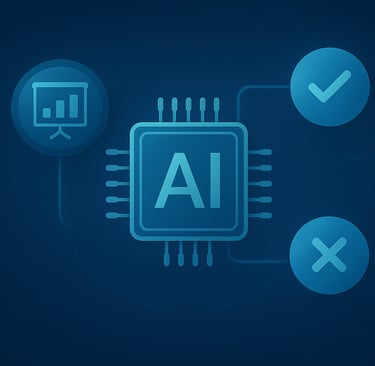
The PowerPoint deck has long been the lingua franca of business decision-making. Executives sift through slides summarizing market analyses, financial projections, and strategic recommendations, each carefully prepared by human analysts. But in 2025, large language models are fundamentally changing this process, moving from passive content creation tools to active participants in structuring the choices that matter most.
LLMs are no longer simply generating the slides—they're building the frameworks that inform what goes on them. Rather than waiting for humans to structure options and surface trade-offs, these systems can now digest vast amounts of organizational data, synthesize competing priorities, and present decision-makers with coherent, structured alternatives complete with identified risks and dependencies.
The Upstream Migration
Recent frameworks show how sophisticated this capability has become. Systems now identify relevant unknown states based on problem descriptions and user goals, forecast values of these states given contextual information, and use this to identify decisions that maximize expected utility. What was once a multi-week process involving teams of analysts can now be compressed into hours or minutes.
In healthcare, LLM-based systems combined with pharmacist oversight have demonstrated 1.5-fold increased accuracy over pharmacists working alone when detecting errors posing serious harm. The pattern is clear: LLMs excel at pattern recognition and comprehensive analysis across large datasets, while humans provide contextual judgment and ethical oversight.
In group settings, LLMs can analyze meeting transcripts to identify discussed options, summarize outcomes, track decision dynamics, and generate recommendations. This moves decision support beyond individual analysis to organizational collaboration, capturing the complex interplay of stakeholder perspectives that traditional tools often miss.
Structuring the Unstructured
The power of LLMs in decision support lies in their ability to transform messy, ambiguous business problems into structured choices. These systems compile, compare, and explain data, offering clear summaries for decision-makers while simulating outcomes and supporting strategy discussions. For executives drowning in information, this represents a fundamental shift from information overload to actionable intelligence.
Consider strategic planning: where consultants once spent weeks gathering data and building decision frameworks, LLMs can rapidly synthesize internal documents, market analyses, competitor intelligence, and financial models into coherent strategic options. They surface hidden trade-offs—cost versus speed, risk versus reward, short-term versus long-term—making implicit assumptions explicit.
The systems are also becoming adept at identifying what's missing. By analyzing decision contexts, they can flag information gaps, suggest additional data sources, or highlight assumptions that require validation. This meta-awareness represents a crucial evolution: LLMs as decision support tools that understand the limits of their own analysis.
The Accountability Imperative
Yet as LLMs move upstream into decision-making processes, the question of accountability becomes more urgent. International frameworks explicitly state that AI systems must not displace ultimate human responsibility and accountability. The technology may structure the choice, but humans must own the consequences.
Humans complement AI by adapting to new scenarios, considering diverse perspectives, and providing the moral compass to ensure that decisions align with societal values. This isn't about inserting a human into the loop as a rubber stamp—it requires meaningful oversight where humans are genuinely empowered to challenge, modify, or reject AI-generated recommendations.
Effective human oversight must be carefully structured, taking into account both the limitations of automated decision systems and the complex dynamics between human operators and machine-generated outputs. Simply having a person review AI recommendations creates what researchers call "automation bias"—the tendency to over-rely on automated suggestions without sufficient critical evaluation.
Organizations need clear governance structures that define accountability at every stage. Who is responsible when an LLM-surfaced option is selected but leads to poor outcomes? Not the algorithm—it has no agency. Not the data scientists who built it—they didn't make the strategic choice. The accountability must rest with the human decision-maker who had the authority, context, and judgment to evaluate the recommendation.
Building Decision Architectures
Forward-thinking organizations are designing "decision architectures" that combine LLM capabilities with human judgment. These frameworks explicitly separate AI's role in structuring options and surfacing information from humans' role in evaluating priorities, assessing ethical implications, and making final choices.
Key elements include:
Transparency requirements: LLMs must explain how they arrived at recommendations, what data informed their analysis, and what assumptions underlie their models. Black-box recommendations are incompatible with accountable decision-making.
Challenge mechanisms: Decision processes should include explicit steps where humans question AI-generated options, stress-test assumptions, and consider alternatives the system may have missed.
Override protocols: Clear procedures for when and how humans can override or modify AI recommendations, with documentation of the reasoning behind divergences.
Audit trails: Complete records of AI-assisted decision processes, enabling retrospective analysis of outcomes and continuous improvement of both systems and human oversight.
The goal isn't to constrain AI's analytical power but to channel it through governance structures that preserve human agency and accountability. LLMs should enhance human decision-making, not replace it—augmenting judgment rather than automating it away.
The Path Forward
As LLMs become more sophisticated at structuring choices and surfacing trade-offs, the distinction between decision support and decision-making will blur further. The challenge for organizations is to embrace the efficiency and insight these systems provide while maintaining unambiguous lines of human accountability.
The future of AI in decision support isn't about choosing between human judgment and machine intelligence. It's about architecting processes where each contributes what it does best: LLMs for comprehensive analysis, pattern recognition, and option structuring; humans for contextual understanding, ethical evaluation, and ultimate accountability.
Those who get this balance right will make better decisions faster. Those who don't may find themselves making fast decisions they can't justify, or slow decisions they can't afford. The technology has moved upstream. The question now is whether our governance frameworks can keep pace.