AI and the Global Divide: Who's Actually Benefiting from LLMs?
The AI revolution promises transformation but delivers inequality. From language barriers affecting billions to data colonialism extracting wealth from the Global South, LLMs are reinforcing existing divides. This article examines who truly benefits from AI and explores concrete pathways toward more inclusive, locally-owned technological development.
11/17/20255 min read
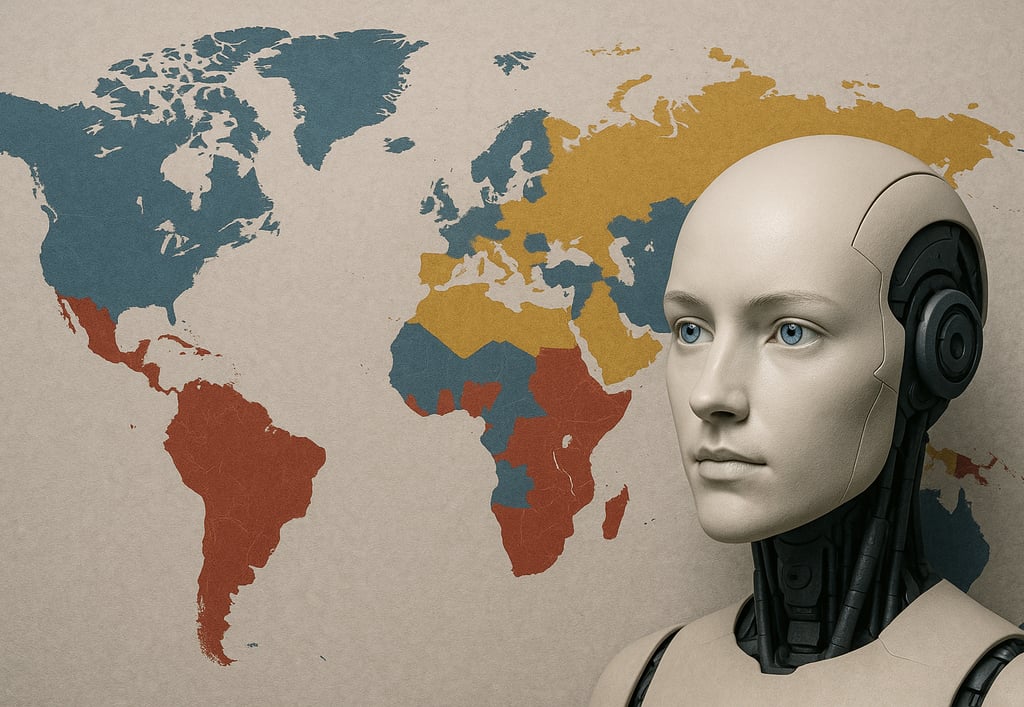
When ChatGPT launched three years ago, the promise was universal: artificial intelligence would democratize knowledge, transform economies, and solve global challenges. Today, as large language models reshape industries from healthcare to agriculture, a troubling pattern has emerged. While Silicon Valley celebrates breakthrough after breakthrough, billions of people remain locked out of the AI revolution—not by choice, but by design.
The statistics tell a stark story. Nearly 2.6 billion people remain offline, unable to access even basic internet services, let alone sophisticated AI tools. Most major LLMs underperform for non-English languages and are not attuned to relevant cultural contexts. When AI systems do reach the Global South, they often arrive as extractive instruments rather than empowering technologies.
The Language Barrier: More Than Words
Language represents one of the most fundamental barriers to inclusive AI. There are over 7,000 languages spoken in the world, yet most AI chatbots are trained on around 100 of them, with English dominating nearly two-thirds of all web content. For someone speaking Swahili, Burmese, or any of thousands of indigenous languages, today's LLMs are largely useless.
LLMs trained mainly on English and Western culture-centric data perform badly in non-Western contexts and languages. The implications extend beyond mere inconvenience. When a farmer in rural India cannot access agricultural advice in their native language, or when a patient in Nigeria struggles to understand AI-generated medical information, the technology fails its most fundamental purpose: serving human needs.
Yet encouraging shifts are underway. In Indonesia, researchers have begun developing Bahasa-based AI models for educational tools, while in South Africa, data scientists are building machine learning models to detect crop disease in local plantations. Singapore's SEA-LION model demonstrates how regional collaboration can produce LLMs tailored to Southeast Asia's linguistic diversity, while Saudi Arabia's ALLaM model, enriched with more than 540 billion Arabic tokens, and India's AI4Bharat laboratory's IndicTrans2 supporting translation across all 22 scheduled Indian languages show that localized AI development is both necessary and achievable.
Data Colonialism: The New Extractive Frontier
Perhaps no concept better captures the current AI moment than "data colonialism"—the extraction of personal and collective data by powerful actors under the guise of innovation. Leading scholars describe this process whereby data from the Global South, particularly Africa, is mined by powerful tech corporations in the Global North, leaving the continent vulnerable to new forms of control and exclusion.
The parallels to historical colonialism are uncomfortably precise. Tech monopolies present exploitations as efforts to "liberate the bottom billion" or connect the "unconnected"—echoing old colonial rhetoric. From fingerprints at borders to dialects harvested by chatbots to satellite scans of farms, Africa's data is being extracted at scale, often with minimal benefit flowing back to local communities.
A Senegalese AI expert warns that most data currently generated in Africa is owned by multinationals whose infrastructure is developed outside the continent. This creates a vicious cycle: African talent migrates to where AI development happens, African data enriches foreign systems, and African communities remain dependent on technologies built elsewhere for other contexts.
The human cost is tangible. Content moderators in Africa receive wages that grossly undervalue their essential contributions to developing AI systems while experiencing severe psychological trauma from constant exposure to disturbing content. The technology sector has found in the Global South a source of cheap labor for the invisible work that makes AI possible—without providing equitable returns.
Infrastructure: The Foundation That's Missing
Beyond language and data, physical infrastructure remains the most basic barrier. Gaps in connectivity, compute capacity, locally relevant data, and digital skills are barriers to inclusive progress. Building and training LLMs requires enormous computational resources—specialized hardware, reliable electricity, and high-speed internet connections that many regions simply lack.
For nations in the Global South, building robust digital infrastructure in remote areas is not merely a matter of connectivity but a prerequisite for enabling equal access to knowledge and economic opportunities. When villages lack reliable electricity, discussions about deploying AI-powered agricultural tools become almost absurd.
The compute divide is particularly stark. Compute is the new electricity in the AI era—essential but unevenly distributed, with supply concentrated among a few firms. Governments face a strategic decision between building domestic compute capacity or securing affordable access to international cloud infrastructure, with neither option being straightforward for resource-constrained nations.
Pathways to Inclusion: What Actually Works
Despite these challenges, concrete patterns are emerging that can make AI deployment more inclusive. The most promising approaches share several characteristics: local ownership, participatory design, and contextual relevance.
Local Language Models: Rather than waiting for Silicon Valley giants to add language support, countries are developing their own models. Open models allow a more diverse pool of developers to stress test systems and adapt them to local cultures and languages. These locally-developed LLMs preserve linguistic diversity and cultural knowledge that would otherwise be erased by globalized AI systems.
Regional Collaboration: Singapore's pitch for AI innovation is that its small size allows systems to be tested and deployed faster than in larger countries, demonstrating how regional cooperation can help countries share resources and leapfrog development. The alternative to expensive individual efforts, collaborative approaches allow pooling of expertise and infrastructure.
Community-Centered Design: Participatory approaches that engage native speakers of low-resource languages contribute to and even co-own the creation of AI resources. This ensures technologies reflect actual community needs rather than assumptions made in distant labs.
Digital Public Infrastructure: International cooperation is needed for infrastructure, data and skills, including developing digital public infrastructure for AI and strengthening capacity-building and research collaboration. Treating fundamental AI capabilities as public goods rather than proprietary assets can accelerate inclusive development.
Ethical Frameworks from the Start: Ethical guidelines must be embedded into AI development from placing humans at the center throughout the loop from start to use, utilizing diverse teams to ensure AI systems are equitable and transparent.
A Fork in the Road
The question facing the global community is not whether AI will transform society—it already is. The question is whether that transformation will replicate centuries-old patterns of extraction and exploitation, or whether we can forge a different path.
Africa risks losing control over its digital data, with it being exported for economic gain without African oversight, potentially losing $3 trillion that AI could add to Africa's economy by 2030. The stakes could not be higher. A continent historically subjected to extraction of land, labor, minerals, and culture cannot afford a new era in which its data becomes the next frontier of exploitation.
There is a real opportunity for the global south to take charge of the AI agenda, as they have the ideas, talent and data to develop AI solutions in local contexts. What's needed is not charity or technological crumbs, but genuine partnership, investment in local capacity, and recognition that AI built by and for diverse communities will ultimately be more powerful and beneficial than systems designed in homogeneous tech hubs.
The AI revolution's ultimate measure won't be how intelligent our systems become, but how intelligently we ensure their benefits reach everyone. Right now, we're failing that test—but the code isn't yet fully written.