2023 in Review: The Year Generative AI Went Mainstream
2023 brought GPT-4, ChatGPT Enterprise, Llama 2, GPT-4V, and DALL·E 3—transforming AI from novelty to infrastructure. Businesses deployed AI in production, education adapted policies, and everyday users formed daily habits around AI assistance. Regulatory frameworks emerged as the technology matured from experimental to essential, fundamentally changing how millions work and create.
12/18/20234 min read

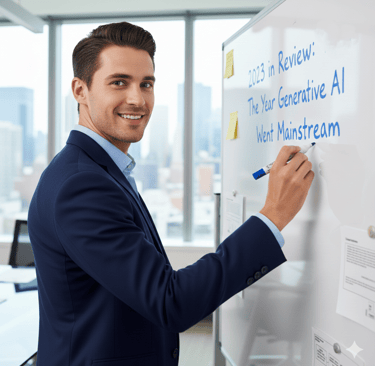
If 2022 was the year generative AI captured imaginations, 2023 was the year it entered everyday reality. What began in November 2022 as a curious chatbot called ChatGPT has, in the span of twelve months, fundamentally altered how millions of people work, learn, and create. As the year closes, it's worth reflecting on how quickly the experimental became essential, the controversial became commonplace, and the future became present.
The Major Launches That Defined the Year
GPT-4's March arrival set the tone for 2023. OpenAI's most capable model delivered meaningful improvements in reasoning, reliability, and domain expertise. The jump from GPT-3.5 to GPT-4 proved large enough to enable new applications—complex analysis, sophisticated coding assistance, nuanced writing—that earlier versions couldn't reliably handle.
Perhaps more significant than the capability increase was the signal it sent: rapid improvement was not only possible but expected. The eighteen months between GPT-3.5 and GPT-4 suggested an aggressive improvement cadence that competitors would need to match.
ChatGPT Enterprise launched in August, addressing the elephant in the room: corporations wanted ChatGPT but couldn't accept consumer-tier data practices. By guaranteeing that customer data wouldn't train models, providing administrative controls, and offering SOC 2 compliance, OpenAI transformed ChatGPT from rogue productivity tool to legitimate enterprise software. The move validated AI as business infrastructure rather than experimental technology.
Meta's Llama 2 release in July proved that frontier AI needn't be exclusively proprietary. With a permissive commercial license and performance approaching GPT-3.5, Llama 2 spawned an ecosystem of derivatives, fine-tunes, and applications that wouldn't exist if foundation models remained exclusively behind API paywalls. The release accelerated open-source AI development by months, possibly years.
GPT-4V arrived in September, bringing vision capabilities to ChatGPT users. The ability to analyze images, interpret charts, read screenshots, and understand visual context transformed ChatGPT from text-only assistant to genuinely multimodal tool. The integration felt seamless—simply upload an image and ask questions—making visual AI accessible to mainstream users for the first time.
DALL·E 3 launched in October, integrated with ChatGPT for natural-language image generation. The improved prompt fidelity and conversational creation process made AI image generation dramatically more accessible and reliable. You no longer needed to master prompt engineering—just describe what you wanted conversationally.
Anthropic's Claude 2 and the subsequent Claude 2.1 updates demonstrated that OpenAI faced genuine competition. Claude's extended context windows, more nuanced responses, and different capability profile gave users meaningful alternatives and pushed OpenAI to continue improving rather than coasting on early leads.
Business Adoption Accelerates
Enterprise AI adoption moved from pilot projects to production deployments at remarkable speed. By year-end, ChatGPT Enterprise claimed thousands of corporate customers. Microsoft 365 Copilot and Google Workspace Duet AI entered preview with major enterprise accounts. Salesforce, ServiceNow, and numerous B2B software providers integrated generative AI features.
The use cases concentrated around familiar territory: customer service automation, content generation, data analysis, coding assistance, and knowledge management. While revolutionary applications remained rare, incremental productivity improvements across countless workflows accumulated into meaningful business value.
Venture capital flowed toward AI startups at unprecedented rates. Companies building on foundation models—specialized assistants, vertical applications, enterprise tools—raised funding at valuations that would have seemed absurd eighteen months prior. The ecosystem matured from pure infrastructure to application layer, as developers discovered what problems AI could actually solve profitably.
Education's Forced Adaptation
Educational institutions spent 2023 grappling with AI's implications, moving from panic to pragmatic adaptation. The initial wave of outright bans proved ineffective and counterproductive. By year-end, forward-thinking schools and universities had shifted toward structured AI policies, revised assessments emphasizing process over product, and AI literacy curricula.
The International Baccalaureate's decision to embrace AI in coursework and assessment, announced mid-year, signaled changing institutional attitudes. The question shifted from "how do we prevent students from using AI" to "how do we teach them to use it responsibly and effectively."
Teachers discovered AI's utility for lesson planning, personalized learning materials, and administrative tasks—becoming users themselves rather than simply policing student usage. This firsthand experience informed more nuanced policies than reactionary bans ever could.
Everyday Life Transformation
For regular users, AI became mundane. ChatGPT on your phone, accessible via voice, integrated with other apps, feels unremarkable now in ways it absolutely didn't at year's start. The transition from novelty to utility happened remarkably quickly.
Usage patterns stabilized around practical applications: summarizing articles, drafting emails, explaining concepts, helping with code, planning projects, and brainstorming ideas. The viral experiments and philosophical conversations faded. What remained were genuine daily habits formed around small productivity improvements that compounded into meaningful time savings.
Browser extensions brought AI assistance to arbitrary web contexts. Mobile apps made it available anywhere. Integration into familiar tools—Microsoft Office, Google Workspace, development environments—embedded AI into existing workflows rather than requiring separate tools.
The Regulatory Response
Governments worldwide scrambled to establish AI governance frameworks. The EU's AI Act approached final passage with risk-based regulations and foundation model provisions. President Biden issued an executive order mobilizing federal agencies toward AI oversight. The UK hosted its AI Safety Summit, positioning itself as global coordinator on AI governance.
These regulatory moves reflected AI's transition from experimental technology to infrastructure requiring oversight. The debates—about appropriate restrictions, innovation incentives, and enforcement mechanisms—will extend well into 2024, but the principle that AI requires governance is now broadly accepted.
What Didn't Happen
For all the change, some anticipated developments didn't materialize. AGI remained safely in the future despite occasional breathless predictions. AI didn't eliminate jobs wholesale—it changed workflows but created new opportunities alongside displacement. The technology didn't solve climate change, cure diseases, or usher in utopia. The hype occasionally exceeded reality.
Many use cases that seemed promising in demos failed in production. Fully autonomous AI agents remained fragile. Complex reasoning still challenged even the best models. Hallucination persisted despite mitigation efforts. The limitations were real, even as capabilities advanced impressively.
Looking Forward
As 2023 closes, generative AI has transitioned from experimental curiosity to established infrastructure. The technology will continue improving—models will become more capable, reliable, and affordable—but the fundamental question has been answered: this technology matters, it's here to stay, and it's changing how we work.
2024 will likely bring continued capability improvements, deeper enterprise integration, and clearer regulatory frameworks. But it probably won't bring the same sense of radical disruption that characterized 2023. The revolution, in a sense, has already happened. What comes next is evolution, refinement, and the hard work of building genuinely useful applications on foundations laid this year.
2023 was the year generative AI grew up. The year it moved from labs to laptops, from demos to daily use, from possibility to practice. The year the future arrived—not with a dramatic bang, but with millions of small moments where someone asked an AI for help and actually got something useful back.